
[40 marks]
45 minutes
1.
The following factors hinder vegetable production in Ghana except?
high cost of agricultural chemicals.
lack of market for farm produce.
irregular rainfall pattern.
availability of sunlight.
2.
The S.I unit of energy is represented as
Joule.
joule.
j.
Js.
3.
A book is at rest on a table. The net force acting on the book could be described as one that
is balanced.
is unbalanced.
is due to friction.
obeys Newton's second law.
4.
An example of a communicable disease is
asthma.
diabetes.
hepatitis.
hypertension.
5.
To stop the spread of a disease caused by a dirty environment, one must
eat healthy diet.
ensure regular exercise.
avoid alcohol.
practice personal hygiene.
6.
An animal feed made up of high fibre is most likely to contain
maize grain.
silage.
soybean.
wheat grain.
7.
Charles Darwin is famous for
discovering penicillin.
his work on the origin of the universe.
his work in the field of physics.
his theory of natural selection.
8.
A mango of mass 2 kg hangs 15 m on top of a mango tree. Determine the value of the kinetic energy attained just before it hits the ground. [g = 10 m s-2]
30.0 J
225.0 J
300.0 J
3.0 J
9.
Which of the following Ghanaian scientists is known for promoting Mathematics and Physics?
Prof. Anamuah Mensah
Prof. Ewurama Addy
Prof. Francis Allotey
Prof. Osei Anto
10.
An example of a mono-gastric animal is
cattle.
goat.
sheep.
rabbit.
11.
Which of the following statements accurately explains the positions of calcium and magnesium in the periodic table? They all have the same
proton number.
valence electrons.
number of shells.
atomic structure.
12.
Which of the following food substances would produce a red precipitate when heated with Millon's reagent?
Banana
Groundnut
Orange juice
Pineapple juice
13.
The rise in heat waves and floods globally may be due to the effect of
climate change.
greenhouse gases.
increased drought.
severe storms.
14.
Which of the following waste disposal practices is best for plastic disposal?
Burning
Composting
Incineration
Recycling
15.
The first step in the digestion of fats in the body is that
bile breaks down the fat in the gall bladder.
bile breaks down the fat in the duodenum.
lipase breaks down the fat in the pancreas.
lipase breaks down the fat in the ileum.
16.
Which of the following organisms is prokaryotic?
Bacteria
Earthworm
Fungus
Plant
17.
Which of the following statements best explains animal feed?
Food grown or developed for livestock
Balanced diet provided to animals
Breast milk served to a calf
Grass that is used to feed livestock.
18.
Which of the following activities does not relate to the principles of pressure in the daily lives of humans?
Drinking straw in use by the people at a party
Pumping air into car tyres
Filling of gallons with air
A person jerking forward when a speeding car suddenly stops.
19.
A patient has been diagnosed of hypertension. Which of the following readings is most likely the patient's blood pressure?
110/85
120/80
130/85
140/90
20.
Which of the following diseases can be classified as a viral disease?
Candidiasis
H1N1
Meningitis
Ringworm
21.
Which of the following associations between two organisms is always beneficial to both?
Commensalism
Mutualism
Saprophytism
Symbiosis
22.
Which of the following substances are major components of human blood?
I. Hormones
II. Platelets
III. Plasma
IV. White blood cells
I and II only
II and III only
III and IV only
II, III and IV only
23.
Combination of science, technology and innovation is needed in Ghana because it
equips students to travel abroad and work.
makes students develop interest in science, technology and innovation.
makes students understand their environment better.
promotes national development.
24.
A rod appears bent when immersed in water. What property of light is demonstrated?
Refraction
Reflection
Dispersion
Rectilinear propagation
25.
Which of the following heart conditions in humans is caused by plaque deposits in the arteries?
Atherosclerosis
Heart attack
Heart failure
Stroke
26.
A grassland ecosystem that consists of snakes, toads and grasshoppers is most likely to produce a food chain of
toad → grass → grasshopper → snake.
grass → grasshopper → toad → snake.
grasshopper → grass → toad → snake.
grass → toad → grasshopper → snake.
27.
A fruit with sour taste is most likely to have a pH that is
less than 7.
greater than 7.
equal to 14.
equal to 7.
28.
Which of the following insect(s) show(s) the egg, nymph and adult stages in its life cycle?
I. Grasshopper
II. Housefly
III. Mosquito
I only
I and II only
II and III only
I, II and III
29.
The term used to describe a rabbit giving birth is
culling.
dubbing.
kindling.
weaning.
30.
Which of the following statements best explains the term ecosystem? It is
a group of organisms of the same species that live in the same place at the same time.
a group of populations living in the same area at the same time.
the part of the earth's environment where life exists.
a community of living and non-living things interacting with each other.
31.
Which of the following types of manure is suitable for a vegetable garden?
Cow dung
Dog faecal waste
Human excreta
Pig dung
32.
A breeding female pig is called a
doe.
gilt.
heifer.
sow.
33.
Which of the following energy sources is/are environmentally friendly?
I. Wind
II. Hydro
III. Biomass
I only
II only
I and II only
I, II and III
34.
Germs that infect the respiratory system are frequently spread through
I. mucus.
II. air pollution.
III. coughs.
I only
II only
II and III only
I, II and III
35.
The chemical formula of iron (II) sulphide is
FeS2.
Fe2S.
FeS.
Fe2S3.
36.
The following soil qualities are important for crop production except
high salinity.
nutrient availability.
oxygen availability.
water-holding capacity.
37.
Which of the following substances has a definite shape?
Air
Kerosene
Stone
Water
38.
The characteristics of a fertile soil include good
I. aeration,
II. texture,
III. water-holding capacity.
I only
I and II only
II and III only
I, II and III
39.
Which of the following statements best explains why gases are more compressible than solids?
Particles in gases are smaller than in solids.
Gases have fixed volume but solids do not.
Particles in solids have definite shape but gases have no definite shape.
Particles in gases have wider intermolecular spaces as compared to solids.
40.
An organism that lives on decaying organic matter, contaminates human food, feeds on rotten fruits and transfers germs is most likely a
fungus.
grasshopper.
housefly.
mosquito.
PAPER 2
ESSAY
[100 MARKS]
2 hours 10 minutes
Answer all the questions in your answer booklet.
This paper is in two sections: A and B. Answer Question 1 in Section A and any other three questions in Section B.
Credit will be given for clarity of expression and orderly presentation of material.
SECTION A
[40 marks]
Answer all the questions in this section
(a)
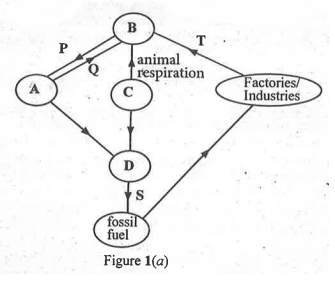
Figure 1(a) is an illustration of a natural cycle showing unnamed stages and processes labelled A, B, C and D with processes labelled P, Q, S and T. Study the figure carefully and answer the questions that follow.
(i)
Name each of the stages labelled A, B, C and D.
(ii)
Name each of the processes labelled P, S and T.
(iii)
State three activities of humans that could disrupt the cycle.
[10 marks]
(b)
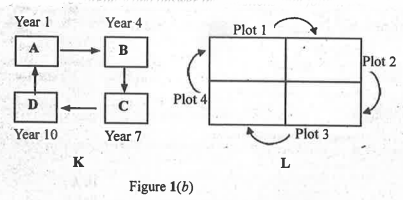
Figure 1(b) is an illustration of two types of farming systems practised in Ghana labelled K and L.
System K represents four farmlands labelled A, B, C and D and the arrows indicate movement of the farmer over a period of time as shown.
System L, represents a farmland divided into four plots 1, 2, 3 and 4 and the arrows indicate the movement of the crops cultivated over the period.
Study the figure carefully and answer the questions that follow.
(i)
Name each of the farming systems labelled K and L
(ii)
Give the reason for each of the names given in (i).
(iii)
State two ways in which the farming system K is of importance to the farmer.
(iv)
Give three reasons why the farming system K is not being encouraged in recent times.
(v)
Name one type of crop that could be included in the farmland L to improve the fertility of the soil.
[10 marks]
(c)
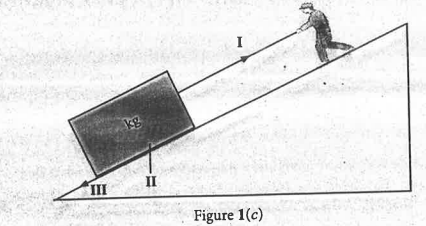
Figure 1(c) is an illustration of a mason pulling a slab by means of a rope up an inclined plane. The labels I, II and III represent forces acting on the slab.
Study the figure carefully and answer the questions that follow.
(i)
Give three examples of the use of inclined planes in everyday life.
(ii)
Given that I is 400 N and moves a distance of 10 m whiles II is 100 N and moves a distance of 5 m, calculate the
(α)
work output;
(β)
work input;
(γ)
efficiency.
[10 marks]
(d)
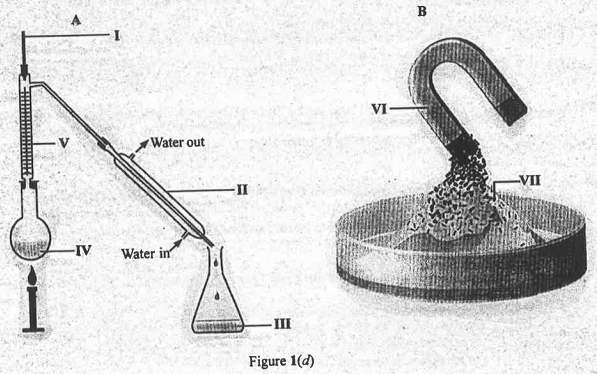
Figure 1(d) is an illustration of experimental set-ups A and B used to demonstrate a scientific principle.
Study the figure carefully and answer the questions that follow.
(i)
Name the scientific principle being demonstrated in both A and B.
(ii)
Describe briefly the functions of each of the parts labelled II and VI.
(iii)
Name any two types of materials that could be present in each of the set-ups labelled:
(α)
III;
(β)
VII.
(iv)
Give the reason why the direction of water flow in A must not be reversed.
[10 marks]
SECTION B
[60 marks]
Answer three questions only in this section
(a)
(i)
State three ways of conserving energy in the house.
(ii)
An electrical appliance in the house uses 4000 W of electric power every 12 hours.
Calculate the energy used within this time.
[7 marks]
(b)
(i)
Give two examples of an acid-base indicator.
(ii)
State the colour change of each indicator given in (i) in an orange juice.
[4 marks]
(c)
(i)
State four activities that could be undertaken to ensure a green economy in Ghana.
(ii)
Name two primary green-house gases associated with industrialization.
[6 marks]
(d)
Describe briefly how compost could be prepared for a backyard garden.
[3 marks]
(a)
Name two:
(i)
animal products used in preparing protein-rich feed for poultry;
(ii)
plant produces used in preparing carbohydrate-rich feed for poultry.
[4 marks]
(b)
Describe briefly the water cycle.
[6 marks]
(c)
Consider the following mixtures:
Air, vinegar.
Air is essential to life.
Vinegar is a common household substance.
(i)
Name the two major components of each mixture.
(ii)
Which of the components named in (i) acts as the solvent in each of the mixtures?
[6 marks]
(d)
(i)
State two reasons why there is no life on the planet Jupiter.
(ii)
List two other outer planets without life.
[4 marks]
(a)
(i)
Explain briefly why a kitchen knife is sharpened in order to cut a piece of yam easily.
(ii)
A force of 10 N is exerted on a piece of yam using a knife of cross-sectional area 1 x 10⁻³ m3.
Determine the pressure exerted.
[6 marks]
b)
Outline the procedure used to estimate the pH value of a soil sample.
[6 marks]
(c)
A patient's blood pressure when measured read 150/90 mmHg.
(i)
State the significance of the values.
(ii)
State three remedies that could be recommended to the patient referred to in (c) other than medication.
[5 marks]
(d)
State three characteristics of silage that has made its use desirable in recent times.
[3 marks]
(a)
Explain briefly how each of the following farming systems are practised:
(i)
organic farming;
(ii)
mixed farming;
(iii)
mixed cropping.
[6 marks]
(b)
Classify a mixture of each of the following pairs of substances as either a homogeneous or heterogeneous mixture:
(i)
oil and water;
(ii)
salt and water;
(iii)
ethanol and water.
[3 marks]
(c)
(i)
Give two reasons why energy from the sun is said to be renewable.
(ii)
State three differences between heat and temperature.
[5 marks]
(d)
Explain briefly two effects each of the following factors on the Nitrogen cycle:
(i)
leaching;
(ii)
removal of leguminous plants.
[6 marks]


Digital Address: GZ-033-0057
King Kotey Road
Teshie - Accra
Ghana
+233 54 753 9118
info@kuulchat.com

© Copyright 2015 - 2026
All Rights Reserved