Finwaver.com
Your school or business runs better on finwaver.com. Sign up for free one (1) week try.
1.
Which of the following shows the relationship between distances on paper and actual distance on the ground?
Longitude
Key
Scale
Plan
2.
1cm to 1 km expressed as representative fraction is
1:100
1:1,000
1:10,000
1:50,000
3.
The earth rotates on its axis, spinning from
East to West
West to East
South to North
West to South
4.
An imaginary line which divides the earth into two hemispheres is called the
latitude
longitude
meridian
equator
5.
Which of the following instruments is used for showing direction?
Thermometer
Compass
Anemometer
Rain Gauge
6.
The difference between the highest and lowest temperature recorded of a place during the day is called the
Daily Range of Temperature
Average Monthly Temperature
Daily Average Temperature
Mean Annual Temperature
7.
An example of a sedimentary rock is
granite
gneiss
marble
clay
8.
The original home of the Ewes was
Ho
Keta
Ketu
Kpando
9.
Ghana became a republic within the Commonwealth of Nations in
1948
1954
1957
1960
10.
The Dagombas are descendants of
Ndewura Jakpa
Samori
Babatu
Dariziogo
11.
Which of the following festivals is associated with fire display?
Bugum
Homowo
Aboakyir
Kundum
12.
A major tributary of River Volta is the
Pra
Ankobra
Oti
Densu
13.
Which of the following towns in Ghana is important for mining of bauxite
Obuasi
Awaso
Tarkwa
Akwatia
14.
In which of the following regions in Ghana is the Akosombo Dam?
Volta
Central
Ashanti
Eastern
15.
The first castle was built in Ghana in 1482 at
Cape Coast
Accra
Axim
Anomabo
16.
All the European powers left the Coast of Ghana by 1872 except the
British
Danes
Dutch
Spanish
17.
The capital of British Gold Coast was moved from Cape Coast to Accra in
1850
1872
1874
1877
18.
Sources of revenue for District Assemblies in Ghana include
Sales tax
purchase tax
basic rates
income tax
19.
A major cash crop to West Africa is
maize
cocoa
plantain
cassava
20.
The most westerly point in West Africa is Cape
Three points
St. Paul
Palmas
Mount
21.
Who is the head of the judiciary in Ghana?
the Speaker of Parliament
the President
the Chief Justice
the Vice President
22.
Maintenance of law and order in the village community is enforced by
an assemblyman
District Chief Executive
Unit Committee elders
chiefs and elders
23.
Foreigners in Ghana enjoy all the following rights except that of
expression
worship
voting
association
24.
Environmental pollution is caused by all the following except
smoking of cigarette
making of loud noise
dumping of refuse
watering of flowers
25.
The farming practice, which combines crop cultivation and animal rearing, is called
Mixed cropping
Mixed farming
Ranching
Nomadism
26.
The tropical rainforest region of West Africa is important for the production of
cattle
millet
tomatoes
groundnuts
27.
. Desertification is caused by
afforestation
excessive rainfall
overgrazing
irrigation
28.
Countries in North Africa are noted for the production of
crude oil
diamond
iron ore
gold
29.
The Prairies of USA is important for producing
cars
diamond
timber
fish
30.
The highest court in Ghana is the
Supreme Court
Magistrate court
High court
Tribunal court
31.
The great pyramids of Egypt were built as
temples for Egyptian gods
palaces for living pharaohs
tourist attractions
royal burial places
32.
Vaccines used in Ghana for the immunization of children are supplied by
District Assemblies
United Nations Educational Scientific and Cultural Organization (UNESCO)
World Health Organization (WHO)
33.
. The main organ of the United Nations Organizations (UNO) is the
General Assembly
Economic and Social Council
International Court of Justice
Security Council
34.
Which of the following animals was mostly used during the Trans-Saharan Trade?
Elephants
Ass
Donkey
Horse
35.
Bush fires occur very often during the
rainy season
harvesting season
marketing days
harmattan season
36.
The common fish caught in the lagoons of Ghana
tuna
herrings
plaice
tilapia
37.
The insect responsible for spreading sleeping sickness is
mosquitoes
tsetsefly
housefly
locust
38.
Which of the following is important in the manufacture of cutting tools?
Tin
Iron
Silver
Lead
39.
Children under the age five years should be immunized against all the following except
polio
tetanus
cholera
diphtheria
40.
The Organization of Africa Unity (OAU) is made up of only
independent African states
dependent African states
colonized African states
black African states
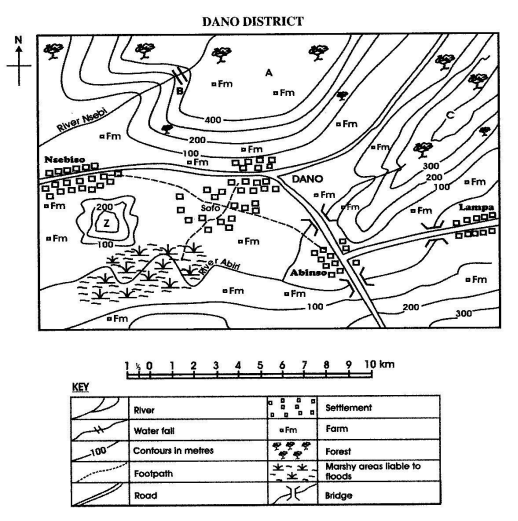
Use the map of Dano District to answer Question 1
a)
State the:
i)
Direction of Nsebiso from Dano
ii)
Contour interval in metres
iii)
Distance by road from Abinso to Lampa in kilometres
iv)
Direction of flow of River Abiri
b)
Name the features marked A, B, C and Z on the map
c)
i)
What type of settlement is at Nsebiso
ii)
What is the main occupation of the people of Dano District?
a)
State five characteristics of the harmattan
b)
In which two ways is the harmattan useful?
c)
Mention three disadvantages of the harmattan
a)
Mention four achievements of Dr. Kwame Nkrumah.
b)
What are the four reasons that led to the overthrow of Dr. Kwame Nkrumah?
a)
Name the four main vegetation types in Ghana.
b)
State four ways by which the vegetation is being destroyed.
c)
Mention two ways by which the vegetation can be protected.
a)
State four good effects that the coming of the Europeans had on West Africa.
b)
What four bad effects did the coming of the Europeans have on West Africa?
a)
What is World Health Organization (WHO)
b)
Mention four achievements of WHO


Digital Address: GZ-033-0057
King Kotey Road
Teshie - Accra
Ghana
+233 54 753 9118
info@kuulchat.com

© Copyright 2015 - 2026
All Rights Reserved