PAPER 1
45 minutes
1.
People who pretend to be what they are not are usually described as
being dishonest.
being disrespectful.
having inferiority complex.
lacking education and training.
2.
One factor which hinders the development of the individual's capabilities is
conducive home environment.
education and training.
guidance and counselling.
reliance on others for initiative.
3.
The knowledge of reproductive features of adolescents enables them to be aware of
their readiness for reproduction.
the needed care and hygiene of the body.
how to practise sex.
how to select the right partner.
4.
Inappropriate behaviour of an individual is likely to result in
child labour.
inferiority complex.
justifiable actions.
strain family ties.
5.
Which of the following socio-cultural practices infringe on the rights of the individual and should therefore be abolished in the Ghanaian society?
Ancestral worship
Chieftaincy
Female circumcision
Traditional marriage
6.
Which of the following pairs of shared values are the most suitable for promoting national integration?
Honesty and kindness
Loyalty and humility
Respect and modesty
Tolerance and hospitality
7.
Which of the following factors is an effect of ethnic conflict in Ghana?
Destoolment and enstoolment of chiefs
Deployment of vigilante groups.
Loss of lives and property.
Population density and immigration
8.
In an attempt to build and maintain peace, it is important that the parties at conflict should
demonstrate tolerance.
expose the mistakes of each other.
insist on their rights.
solicit the services of a good lawyer.
9.
One major factor that impedes the promotion of science and technology in Ghana is
belief in superstition.
technological disaster.
the spread of diseases.
the use of indigenous technology.
10.
In which of the following ways does the world use science and technology for development?
I. Development of communication gadgets
II. Employment of skilled labour
III. Introduction of agriculture machines
IV. Manufacture of drugs, food and chemicals
I and II
II and IV
II, III and IV
I, III and IV
11.
One factor that best explains insufficient exploitation and utilization of natural resources in Ghana is the lack of
capital to purchase equipment.
indigenous human resource at the rural areas.
industrial companies to employ more people.
training and retraining programmes for the people.
12.
Money, tools and equipment used to provide services are called
capital.
fixed assets.
incentives.
utilities.
13.
A consequence of broken home is
child delinquency.
domestic violence.
incompatibility.
infidelity.
14.
One reason for which people contract marriage is to
escape from hard work.
bear and nurture children.
gain permanent employment.
secure traditional inheritance.
15.
The family as an institution is important because it
caters for both nuclear and extended members.
gives financial support to members.
provides identity and sense of belonging.
provides for children's education.
16.
Provision of financial and physical needs of the family by the father helps to ensure
control over members.
effective use of leisure time by children.
equitable distribution of property.
harmonious living among members.
17.
The term parenting refers to the
act of feeding a child.
act of giving birth to a child.
activity of bringing up a child.
state of being a biological mother.
18.
Engaging children in economic activities which may hinder their education and endanger their health is
child abuse.
child abduction.
child labour.
child neglect.
19.
Parenthood starts as soon as a child is
adopted.
born.
conceived.
named.
20.
Which of the following conditions is not an effect of deviant behaviour in the society?
Breakdown of law and order
Loss of manpower
Peer pressure
Stifling development projects
21.
The agency that greatly helps in the achievement of national objective is
the community.
the extended family.
religious bodies.
the school.
22.
Socialization helps the individual to
become a responsible citizen.
obtain better education.
obtain white-collar job.
select a good partner.
23.
A feature of democratic governance that is for stability in a nation is
existence of regular army.
flamboyant appearance of politicians.
peaceful transition of power.
provision of social amenities.
24.
A constitution of a country
describes the rule of governance.
differentiate between the ruler and the ruled.
establishes the state.
is made up of act of parliament.
25.
The practice of democracy promotes unity and development mainly because of the
existence of independent judiciary.
involvement of the people in decision making.
provision of social amenities.
regular inflow of foreign aid.
26.
Which of the following statements best describes the physical environment? The
building and other structures in our communities.
landforms, vegetation and climatic conditions.
mountains, lowlands and rivers in our communities.
external surroundings within which all living things live.
27.
Which of the following activities is detrimental to the environment?
Afforestation
Aqua culture
Bush burning
Irrigation
28.
The environment can be protected through
adopting small scale agriculture practices.
burning bushes around our home.
recycling domestic and industrial waste.
the use of tractors in farming.
29.
Under which of these circumstances would the law limit the right of citizens?
Engaging in lawful occupation
Accessing basic education
Lawful movement
Mental infirmity
30.
The right of an individual to move about freely is an example of
legal rights.
natural rights.
political rights.
social rights.
31.
The main reason for which individuals should perform their responsibilities to their communities is to
avoid sanctions.
ensure harmonious living.
protect the environment.
provide natural service.
Use the population data below to answer questions 32 to 34.
| Age groups (years) | Population | Percentages |
| 0 - 19 | 10,759,000 | 53.4 |
| 20 - 59 | 8,455,122 | 42.0 |
| 60 and above | 920,000 | 4.6 |
32.
The percentage of the dependency group is
58.0 per cent.
53.4 per cent.
46.6 per cent.
42.0 per cent.
33.
What percentage of the population constitutes the working force?
95.4 per cent
53.0 per cent
46.6 per cent
42.0 per cent
34.
The population statistics represent
high dependency ratio.
low dependency ratio.
low fertility ratio.
high mortality rate.
35.
Which of the following will tend to decrease the size of a country's population?
I. A rise in emigration
II. Improvement in health facilities
III. A decline in the fertility rate
IV. A fall in the mortality rate
I and III only
II and IV only
II, III and IV only
I, II and III only
36.
An example of positive attitude to work is
avoiding absenteeism at work.
improper dressing to work.
improper way of talking to co-workers.
refusing to be punctual.
37.
A quality of an entrepreneur is
decision making.
innovativeness.
risk bearing.
supervision.
38.
The ratio between measurement on a map and the actual corresponding distance on the ground is
a longitude.
a scale.
a latitude.
an isotherm.
39.
The scale on the map is 200,000. If the distance on the map is 2 cm, find the actual distance on the ground?
1.2 km
20 km
2 km
4 km
40.
A person's perceptions, beliefs, abilities and feelings constitute his/her
conduct.
image.
physique.
self.
This paper consists of three sections: I, II and III. Answer three questions only. One compulsory question and two other questions from section II and III respectively. All questions carry equal marks.
SECTION I
(COMPULSORY)
THE ENVIRONMENT
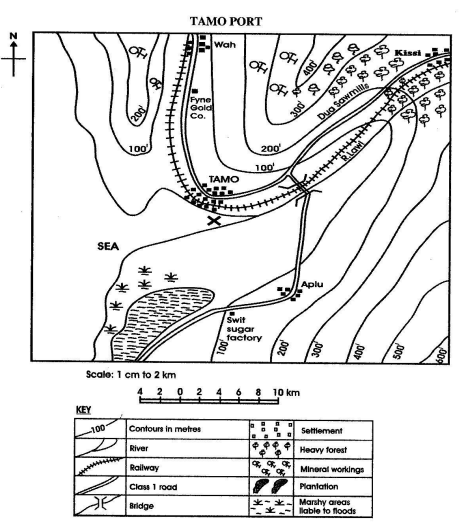
Use the map of Tamo to answer Question 1
a)
What is the direction of Kissi from Tamo?
b)
Calculate the distance in kilometres along the class one road from Aplu to the bridge across River Lawi
c)
What is the direction of flow of River Lawi?
d)
Name the feature marked X at the mouth of River Lawi
e)
Mention the main two lines of communication of the area.
f)
Using the map only, name two products that are likely to be exported through the Tamo port.
SECTION II
FAMILY, LAW AND ORDER
Answer one question only from this section.
(a)
How can the Ghana Police Service be made much more effective in the maintenance of law and order?
(b)
Identify four challenges mostly associated with democratic governance in Ghana.
(a)
(i)
Explain adolescent reproductive health
(ii)
List four responsible behaviours of the adolescent
(iii)
As an adolescent, justify five irresponsible behaviours you must avoid.
(b)
(i)
Differentiate between parenting and parenthood.
(ii)
Discuss four effects of irresponsible parenting on the child.
SECTION III
SOCIAL AND ECONOMIC DEVELOPMENT
Answer one question only from this section.
(a)
What is human resource?
(b)
Discuss how human resource can be developed for national development.
(a)
Explain the term natural resources.
(b)
In what four ways are natural resources beneficial to Ghanaians.
(c)
Examine the factors responsible for the under-utilization of natural resources in Ghana.


Digital Address: GZ-033-0057
King Kotey Road
Teshie - Accra
Ghana
+233 54 753 9118
info@kuulchat.com

© Copyright 2015 - 2026
All Rights Reserved