
Finwaver.com
Your school or business runs better on finwaver.com. Sign up for free one (1) week try.
[40 marks]
45 minutes
1.
Which of the following is not a noble/inert gas?
Argon
Helium
Neon
Nitrogen
2.
How does the atomic number of elements in Group 1 affect their valency?
Valency increases with increasing atomic number
Valency decreases as atomic number increases
Valency remains the same across the group despite the increase in atomic number
Valency fluctuates with atomic number
3.
Which of the following elements has zero valency?
Lithium
Beryllium
Helium
Flourine
4.
The ...... is a jelly-like substance in which chemical reactions take place
cytoplasm
nucleus
chloroplast
cell membrane
5.
The ...... holds the cytoplasm together and controls which substances pass into and out of the cell
nucleus
vacuole
cell membrane
lysosome
6.
The function of mitochondria is ......
for photosynthesis
to absorb light
protect the cell
release energy
7.
Most cells contain ...... for protein synthesis
ribosomes
cytoplasm
mitochondria
chloroplast
8.
Plant cells contain ...... to strengthen the cell
cytoplasm
cell wall
ribosome
mitochondria
9.
What is the process called when liquid water turns into water vapor (a gas)?
Condensation
Evaporation
Precipitation
Collection
10.
Which process forms clouds in the water cycle?
Evaporation
Condensation
Precipitation
Runoff
11.
Transpiration is the release of water vapor from:
Oceans
Rocks
Plants
Clouds
12.
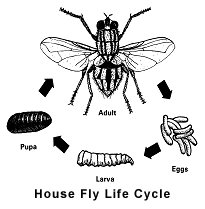
How many stages are in the housefly's life cycle?
2
3
4
5
13.
Approximately how long does the entire life cycle of housefly take under ideal conditions?
3-5 days
7-10 days
30 days
60 days
14.
Where do female houseflies typically lay their eggs?
On living plants
In clean water
In decaying organic matter (manure, garbage)
Inside other insects
15.
The micro nutrient necessary for the development, growth and well-being of the plant is
Nitrogen
Phosphorus
Potassium
Chlorine
16.
Absorption of water by plant roots is an example of ......
transpiration
guttation
osmosis
diffusion
17.
Animals living with humans for companionship or work are called:
Wild animals
Domestic animals
Insects
Aquatic animals
18.
The skin of some domestic animals is used to make:
Plastic
Paper
Leather
Cloth
19.
Which of the following is not a function of the digestive system?
eliminate nondigestible wastes
eliminate nitrogenous wastes
ingest food
breakdown food to smaller, absorbable molecules
20.
Saliva contains the enzyme
amylase
lipase
pepsin
peptidase
21.
Define gingivitis.
Dry mouth
Inflammation of the gums
Loss of bone.
Tooth decay
22.
Identify the type of teeth that help tear food.
incisors
canines
premolars
molars
23.
What is the function of bile?
neutralize chyme
emulsify fats
absorb amino acids
regulate cholesterol levels
24.
Which of the following is not a normal function of the bacteria living in the large intestine?
breakdown some indigestible material
produce B-complex vitamins
produce vitamin K
cause disease and infection
25.
A 5 Kg body is having a Kinetic energy of 250 J. What is the velocity of the body?
10 m/s
15 m/s
20 m/s
40 m/s
26.
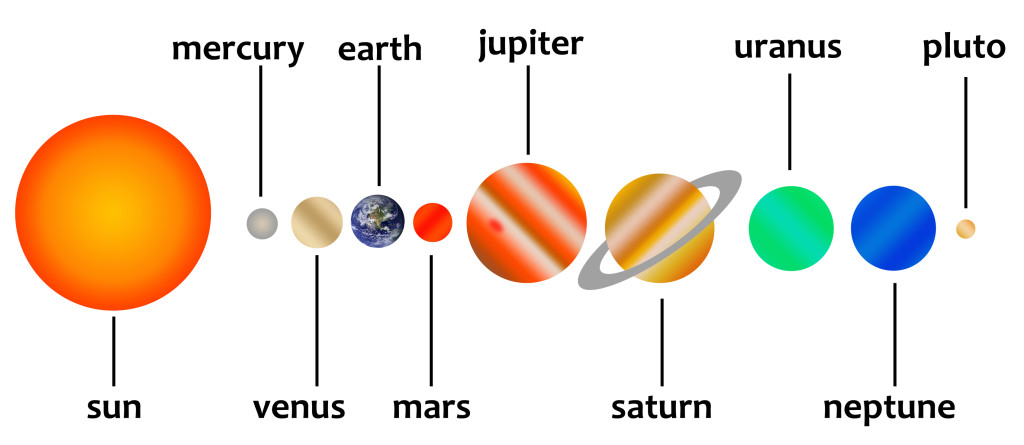
The planet nearest to the sun is
Earth
Mars
Mercury
Venus
27.
What causes day and night on Earth?
Earth's orbit around the Sun
Earth's rotation on its axis
The Moon's shadow
The Sun's movement
28.
The interaction in which one species benefits and other is neither harmed nor benefited is termed as ......
Mutualism
Parasitism
Communism
Commensalism
29.
In a food chain, secondary producers are ......
omnivores
herbivores
carnivores
decomposers
30.
...... is a community where living organisms interact among themselves and also with the surrounding physical environment.
Family
A universe
An ecosystem
A herd
31.
A 10 kg object is raised to a height of 20 m. What is the magnitude of its potential energy?
[Take g = 10 ms-2]
500 J
1000 J
1500 J
2000 J
32.
A 1500 W heater runs for 2 hours. How much energy does it consume?
1.5 kWh
2 kWh
3 kWh
4 kWh
33.
Two resistors each 5 Ω are connected in parallel. Determine their effective resistance.
2.5 Ω
6.4 Ω
10.0 Ω
25.0 Ω
34.
The practice of growing cowpea and maize on a piece of land at the same time is known as
mixed farming.
mixed cropping.
land rotation.
crop rotation.
35.
An advantage of practicing organic farming is that it
increases soil fertility.
reduces pest infestation.
reduces toxicity levels in plants.
increases resistance to plant disease.
36.
Which of the following crops should be planted after cassava in crop rotation?
Cocoyam
Cowpea
Onion
Yam
37.
The energy output of a system is 40 J and the efficiency is 50%. Determine the energy input of the system.
50.0 J
80.0 J
24.0 J
75.0 J
38.
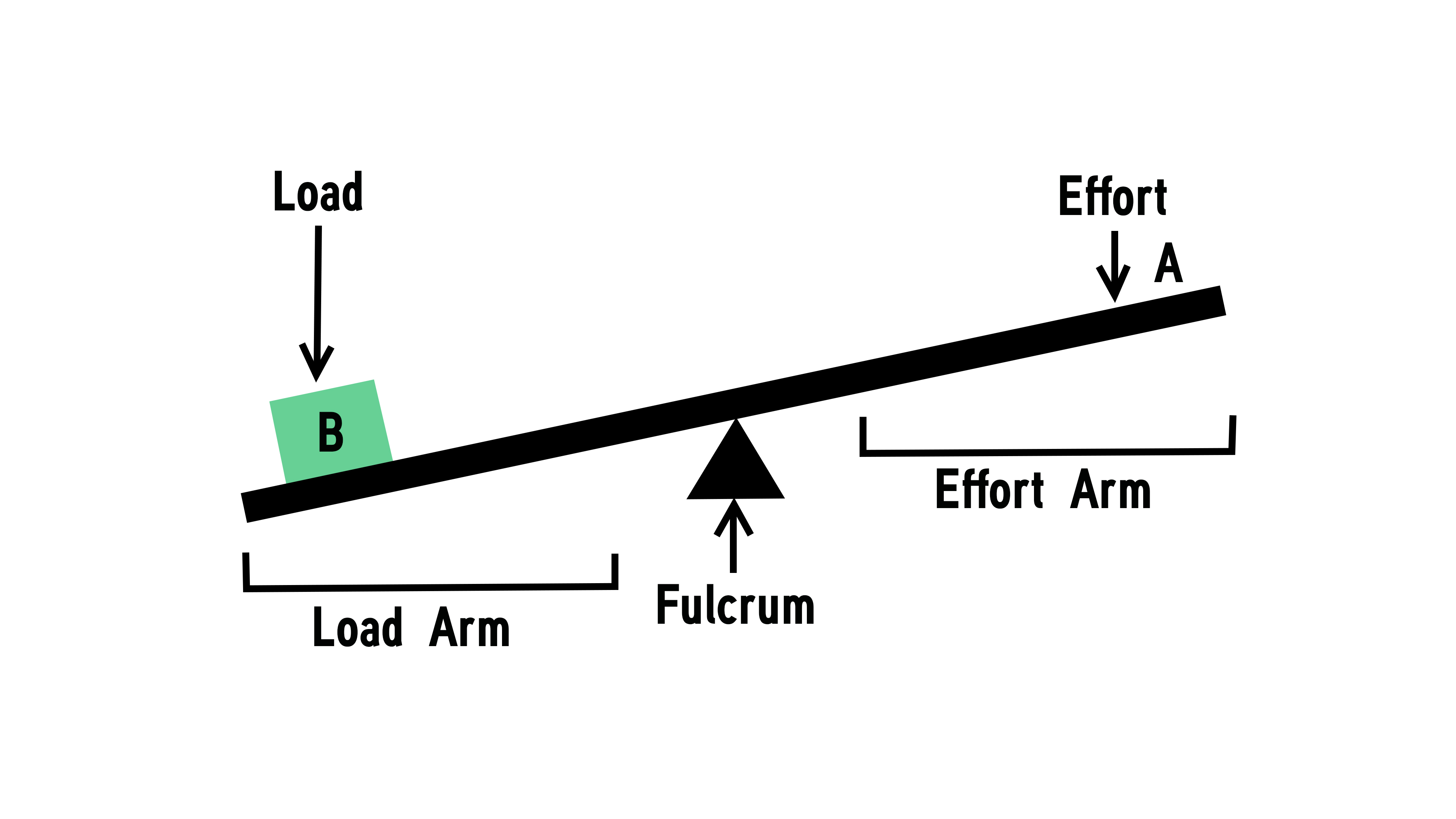
An example of a first class lever is
bottle opener.
crow bar.
wheel barrow.
fishing rod.
39.
A machine lifts a load of 100 N through a vertical distance of 2 m in 10s.
What is the power of the machine?
50 W
20 W
10 W
2 W
40.
When light travels from one transparent medium to another, it may change direction. This process is called:
Rectilinear propagation
Reflection
Refraction
Absorption
[100 MARKS]
2 hours 10 minutes
Answer all the questions in your answer booklet.
This paper is in two sections: A and B. Answer Question 1 in Section A and any other three questions in Section B.
Credit will be given for clarity of expression and orderly presentation of material.
SECTION A
[40 marks]
Answer all the questions in this section
(a)
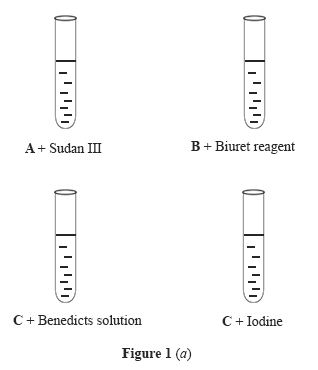
Figure 1 (a) is an illustration of test tubes that produced positive for a food testing experiment conducted to investigate the food substances A, B, C and D.
Study the figure carefully and answer the questions that follow.
(i)
Identify the food substances A, B, C and D.
(ii)
What color of precipitate was formed in each test tube?
(iii)
State the part(s) of the digestive system where the food substances A, B and D are digested.
(iv)
State the end product of digestion for each of the food substances A, B and D.
(v)
State one function of each of the food substances A, B and D.
[10 marks]
(b)
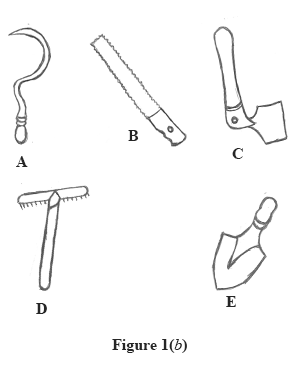
The Figure 1(b) is an illustration of some farm tools.
Study the figure carefully and answer the questions that follow.
(i)
Identify the farm tools illustrated in diagrams A, B, C, D and E.
(ii)
State one use of each of the farm tools illustrated in diagrams A, B, C, D and E.
(iii)
State three ways of maintaining the farm tools illustrated in the diagrams.
(iv)
Mention one farm tool that could be used in place of the farm tool illustrated in diagram B
[10 marks]
(c)
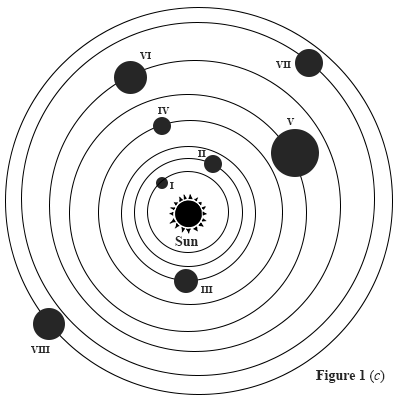
The Figure 1(c) is an illustration of a scientific system.
Study the figure carefully and answer the questions that follow.
(i)
Name the system illustrated above.
(ii)
Name each of the parts labelled I, II, III, IV, V, VI, VII and VIII
(iii)
Which part is the hottest
(iv)
Which part is knowns as the "Red" part?
(v)
Which part is known for its prominent rings?
(vi)
Which parts are terrestrial (rocky)?
(vii)
State three characteristics of the part labelled III
[10 marks]
(d)
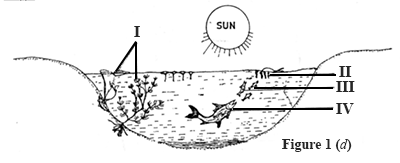
The Figure 1(d) is an illustration of organisms in a habitat.
Study the figure carefully and answer the questions that follow.
(i)
Name the habitat.
(ii)
Name the trophic level occupied by each of the organisms I, II, III and IV in the habitat.
(iii)
Construct a food chain using the organisms labelled in the diagram.
(iv)
What is the role of the sun in the habitat?
(v)
If the organisms labelled I are absent, what would be the effect on the habitat?
(vi)
Name two:
(α)
biotic components in the habitat;
(β)
abiotic components in the habitat.
(vii)
State the mode of nutrition of each of organisms I, II, III and IV.
(viii)
State one adaptive feature of the organisms labelled I to their mode of life in the habitat.
[10 marks]
SECTION B
[60 marks]
Answer three questions only in this section
(a)
(i)
State two differences between the properties of solids and gases
(ii)
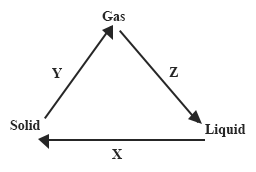
What process does each of X, Y, and Z represent in the changes shown below?
(iii)
State two properties of liquids
(iv)
State three ways of conserving water in the home.
[5 marks]
(b)
Give two examples each for the following:
(i)
metals;
(ii)
non-metal;
(iii)
noble gases.
[3 marks]
(c)
(i)
What is a cell?
(ii)
Name one scientist that is associated with the discovery of the cell.
(iii)
State two differences between plant and animal cells.
[6 marks]
(d)
(i)
Define the term work done
(ii)
A student pushes a science textbook across a horizontal lab bench with a constant horizontal force of 15 N for a distance of 1.2 m.
Calculate the total work done by the student on the textbook.
[6 marks]
(a)
(i)
List three modes of heat transfer.
(ii)
Name the type of medium in which each mode of heat transfer you have listed in (i) takes place.
(iii)
State two effects of heat on a substance.
[5 marks]
(b)
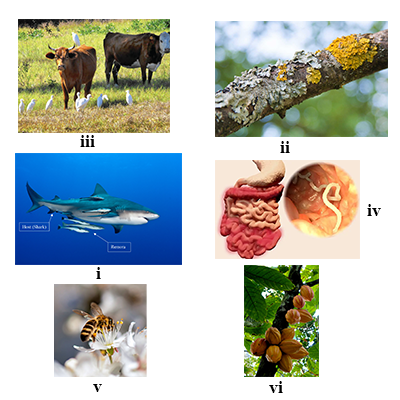
Classify the following biological associations under the headings in the table below:
(i)
Remora and shark;
(ii)
Lichen;
(iii)
Cattle and white Egret;
(iv)
Tapeworm in the gut of humans;
(v)
Flowers and Honeybees;
(vi)
Mistletoe and Cacao plant.
| Parasitism | Mutualism | Commensalism |
[3 marks]
(c)
Consider the given elements: 12 X and 1735 Y
(i)
Write the electronic configuration for each elements
(ii)
State the number of protons, electrons and neutrons in each elements.
(iii)
What type of bond can be formed between the two elements and why?
(iv)
Identify each of the elements.
[6 marks]
(d)
(i)
State two similarities between eukaryotic and prokaryotic cells
(ii)
State two differences between eukaryotic and prokaryotic cells
(iii)
State one example of an organism made of each cells.
(iv)
State one impact of both eukaryotes and prokaryotes.
[6 marks]
(a)
(i)
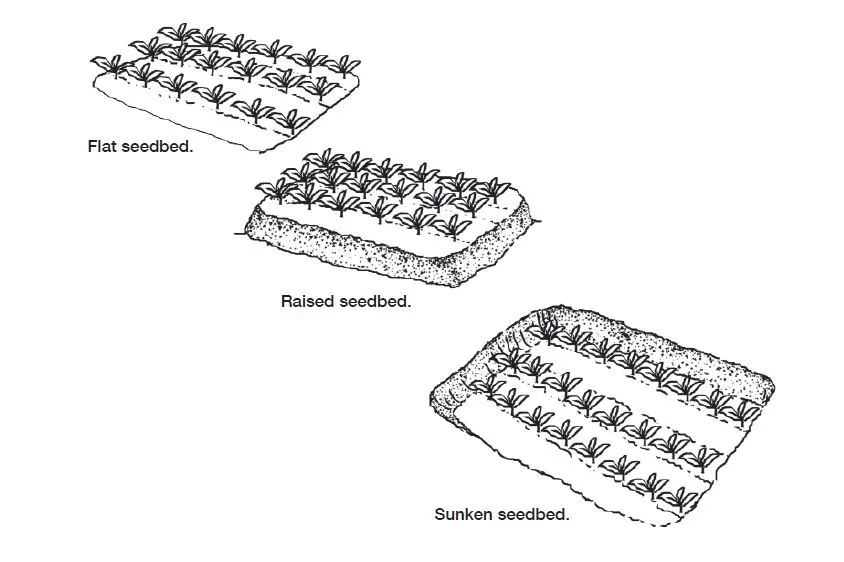
What is a seed bed?
(ii)
State and explain briefly three types of seed beds
(iii)
Give one example of crop that can be grown on each type of seed bed stated in a (ii)
(iv)
State two benefits for preparing a seed bed
[6 marks]
(b)
(i)
Explain the term ration as used in animal production.
(ii)
Explain how each of the following factors influence feed formulation for farm animals
(α)
physiological status of animal;
(β)
age;
(γ)
purpose of production.
(iii)
State three ways in which water is essential in animal nutrition.
[4 marks]
(c)
(i)
Define the term pressure.
(ii)
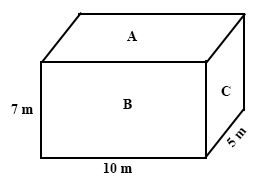
The force exerted by the box above on the floor is 100 N.
A student wishes to place the box to exert the highest pressure. Which side A, B and C should the student place on the floor and why?
[4 marks]
(d)
(i)
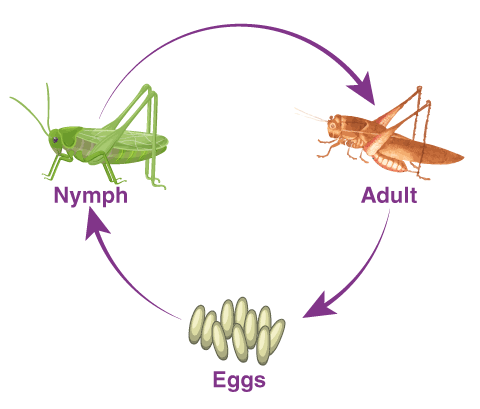
State the life cycle of a grasshopper.
(ii)
Explain briefly why the life cycle of the grasshopper is described as incomplete metamorphosis.
(iii)
State two effects of grasshoppers.
(iv)
State two ways of controlling grasshoppers.
[6 marks]
(a)
(i)
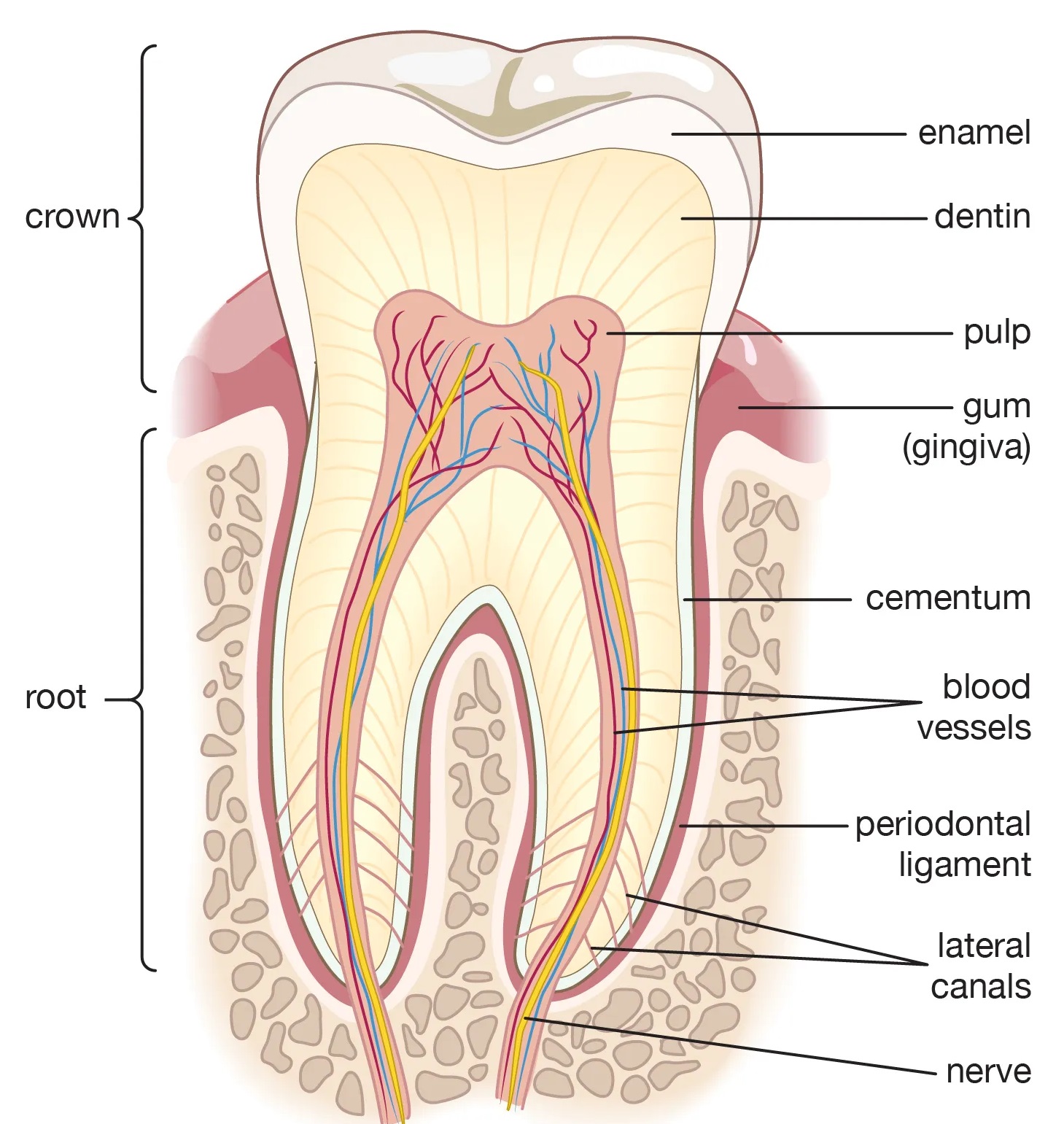
State the parts of the mammalian tooth.
(ii)
State the function of each of the parts stated in (i)
(iii)
Describe the proper ways of cleaning the teeth
[6 marks]
(b)
Explain each of the following terms as used in ecology:
(i)
producer;
(ii)
primary consumer;
(iii)
secondary consumer;
(iv)
food chain;
(v)
food web.
[5 marks]
(c)
Explain how life on earth will be like without the sun
[4 marks]
(d)
(i)
Define each of the following terms:
(α)
renewable energy;
(β)
non-renewable energy.
(ii)
Classify the following sources in the table below:
Wind, coal, hydro, crude oil, natural gas, geothermal, solar and biogas
| RENEWABLE | NON-RENEWABLE |
[5 marks]


Digital Address: GZ-033-0057
King Kotey Road
Teshie - Accra
Ghana
+233 54 753 9118
info@kuulchat.com

© Copyright 2015 - 2026
All Rights Reserved