

Finwaver.com
Your school or business runs better on finwaver.com. Sign up for free one (1) week try.
1.
Which of the following electronic components is not made of semi-conductors?
Capacitor
Diode
LED
Transistor
2.
The base of the N-P-N transistor normally
is a p-type semi conductor.
is an n-type semi conductor.
is undoped semi conductor.
have electrons as majority charge carriers.
3.
A capacitor is connected in a series circuit with LED, a battery and a switch. When the circuit is closed, the LED
comes on and stays on.
flashes and goes off.
does not come on.
flashes and stays on.
4.
The diagram below is an illustration of a transistor.
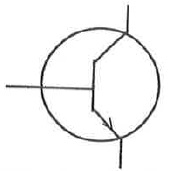
The arrow shows the direction of:
electron movement.
hole movement.
electron and hole movement.
negative charge movement.
5.
Which of the following devices is made of semiconductor?
Capacitor
Inductor
Resistor
Transistor
6.
In electronic circuits, LEDs are used to indicate the absence or presence of
emitter and collector
electric current
p-n junction
voltage source
7.
Which of the following statements about the base of a transistor are correct? The base is
I. made very thin
II. made very wide
III. responsible for activating the transistor
IV. made of n-type semiconductor
I and III only
II and IV only
I, III and IV only
II, III and IV only
8.
The diagram below represents a circuit symbol in an electronic device. Study it carefully and use it to answer the question below.
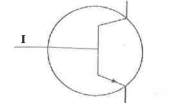
The symbol represents
a light emitting diode.
n-p-n transistor.
light dependent resistor.
p-n-p transistor.
9.
The diagram below represents a circuit symbol in an electronic device. Study it carefully and use it to answer the question below.
The part of the diagram labelled I has
more electrons than holes.
no holes.
more holes than electrons.
the same number of holes as electrons.
10.
Which of the following statements about a transistor is correct?
It can be used to amplify current.
It is similar to three diodes.
It consists of two leads only.
It has three junctions.
11.
In an n-p-n transistor, the n-type collector is connected to the positive terminal of the battery thus making the
base-collector junction reverse biased.
base-collector junction forward biased.
base-emitter junction reverse biased.
base-emitter junction forward biased.
12.
Which of the following devices requires the use of transistors in its operation?
Computer
Electric heater
Microphone
Wall clock
13.
When the p-n junction of a transistor is reversed biased
current flows from the p-type to the n-type.
no current flows from the p-type to the n-type.
conduction of current occurs.
current flows from the n-type to the p-type.
14.
The arrow in the circuit symbol of either n-p-n or p-n-p transistor is always on the
base lead.
collector lead.
emitter lead.
receiver lead.
15.
A transistor is said to operate in an active region when
one p-n junction is forward biased and the other is reverse biased.
base-emitter junctions are reverse biased.
both p-n junctions are reverse biased.
base-collector junction is forward biased.
16.
Which of the following electronic components are used to produce oscillator circuits?
I. Transistor
II. Inductor
III. Capacitor
I and II only
I and III only
II and III only
I, II and III
17.
The lead of the transistor responsible for activation is the
amplifier.
base.
collector.
emitter.
18.
Which of the following devices is made of semiconductor?
Capacitor
Inductor
Resistor
Transistor
19.
In electronic circuits, LEDs are used to indicate the absence or presence of
emitter and collector
electric current
p-n junction
voltage source
20.
The process of increasing the strength of a signal using a transistor is known as
amplification.
biasing.
doping.
switching.
21.
The number of p-n junctions in a transistor is
1
2
3
4
22.
The majority charge carriers is a p-type semi-conductor are
electrons.
holes.
neutrons.
protons.
23.
The major charge carriers in p-type semiconductors are
anions
electrons
holes
neutral
24.
The transistor in an electronic device is used
I. as a switch
II. for amplifying alternating signals
III. in preventing overheating in electric irons
I only
I and II only
I, II and III
I and III only


Digital Address: GZ-033-0057
King Kotey Road
Teshie - Accra
Ghana
+233 54 753 9118
info@kuulchat.com

© Copyright 2015 - 2026
All Rights Reserved