
Finwaver.com
Your school or business runs better on finwaver.com. Sign up for free one (1) week try.
1.
Green plants have the ability to make their own food hence they are known as
producers.
parasites.
consumers.
decomposers.
2.
Producers in an ecosystem are plants that
attract insects
feed on other plants
feed on dead materials
manufacture their own food
3.
Grasshopper management is crucial because of all the following reasons except
damage to crops.
incomplete metamorphosis.
ecosystem disruption.
livestock harm.
4.
Green plants have the ability to make their own food hence they are known as
producers.
parasites.
consumers.
decomposers.
5.
All of the following are herbivores except
sheep
dog
goat
grasscutter
6.
A fish dies shortly after being removed from water. This is because it
cannot swim
is streamlined
is hot on land
has scales
7.
Which of the following habitats are you likely to find a tadpole?
Bush
Sea shore
Pond
Deep well
8.
9.
Which of the following is not a mammal?
Whale
Bat
Cat
Hen
10.
Which of the following animals can live both in water and on land?
Mouse
Rat
Frog
Grasscutter
11.
All of the following animals lay eggs except
fish
lizard
rabbit
toad
12.
The lion is a typical example of
a pet
a carnivore
an omnivore
a herbivore
13.
Which of the following human activities causes pollution of the environment?
Cutting down timber in the forest for firewood
Overgrazing of the field by cattle
Burning of coal and petrol in industries
Building dams across rivers
14.
Which of the following statements about feeding relationships is not true?
Energy is transferred from one organism to another
A green plant is the basis of any food chain
Bacteria feed on dead organisms for energy
A carnivore feeds on green plants for energy
15.
16.
Which of the following gases is not an air pollutant?
cigarette fumes
carbon dioxide
sulphur dioxide
exhaust fumes
17.
During the dry season most trees shed their leaves to
protect the tree
avoid being pulled down by strong winds
conserve water and nutrients
discourage animals from eating the leaves
18.
Which of the following living organisms is not a reptile?
Lizard
Tortoise
Frog
Snake
19.
The following are steps involved in how nutrients in decaying organic matter finally get to man.
I. The mineral in them go into the soil
II. Man goes to eat the plant food
III. They dissolve in soil water
IV. They are used up by plants during photosynthesis
Which of the following arrangements represents the correct order in which the processes occur?
I, II, III and IV
I, III, IV and II
IV, II, III and I
II, III, I and IV
20.
21.
Animals that live in grasslands include
lions and giraffes
monkeys and tigers
antelopes and hares
woodpeckers and baboons
22.
Which of the following living things hide during the sunny days in order to conserve water in its body?
Rat
Lizard
Butterfly
Toad
23.
Most plants will not do well in the desert because
there is no top soil
it is too sunny there
rainfall is very poor
the speed of wind is high
24.
Which of the following features is common to both the fish and the lizard? The possession of
a sticky tongue
a lateral line system
dorsal fins
clawed digits
25.
Birds are able to fly because they have
hollow bones
web legs
tail feathers
flat chest
26.
Trees in desert regions have thick barks which enables them to
prevent heat loss
absorb more light
prevent water loss
absorb more water
27.
Which of the following activities of man causes both air and water pollution?
Afforestation
Construction of houses
Construction of roads
Deforestation
28.
The shedding of leaves by plants during the dry season protects them against
bush fire
cold weather
plant-eating animals
heat loss
29.
Which of the following pairs of organisms are decomposers?
Animals and bacteria
Animals and fungi
Bacteria and plants
Bacteria and fungi
30.
Which of the following features in plants are used for defence?
Buds
Leaf spines
Pitchers
Roots
31.
The ability of birds to fly depends on
Their hollow hones only
Their flight feathers only
Their feathers covering their bodies
Their hollow bones and flight feathers
32.
Which of the following substances is a pollutant?
Domestic waste
Fog
Nitrogen
Oxygen
33.
The food chain that occurs in nature is
green plans → lizards → insects → snakes
grasshopper → green plants → lizards → hawks
green plants → snakes → hawks → man
green plants → grasshopper → lizards → snakes
34.
Which of the following statements about mammals is true?
They have hairs
They lay eggs
They have feathers
They have beaks
35.
Desert plants shed their leaves to reduce the rate of
absorption of minerals.
diffusion.
osmosis.
respiration.
36.
The main pollutant from domestic fires is
carbon monoxide.
sulphur dioxide.
water vapour.
oxygen.
37.
Tendrils in plants are adaptations that enable the plant to
climb.
expire.
store food.
reproduce.
38.
A beak and claws are protective structures of a
crab.
hawk.
lion.
snake.
39.
Human beings are omnivorous because they eat
both cooked and raw food.
only flesh.
only fruits.
both plants and animals.
40.
Animals depend on plants for food because
animals do not need to drink water.
only plants can make their food from simple substances.
only plant food can satisfy animals.
plants are available everywhere.
41.
Which of the following animals has a body temperature which changes with the temperature of the surroundings?
Butterfly
Crow
Rabbit
Toad
42.
Which of the following arrangements is a probable food chain.
Grass → Grasshopper → Toad → Snake → Crow
Grasshopper → Grass → Goad → Lion → Man
Crow → Snake → Toad → Grasshopper → Grass
Grass → Goat → Lion → Man → Snake
43.
The major cause of pollution at a stone quarry is
dust.
human waste.
acid disposal.
smoke.
44.
The lion is a carnivore because it eats
flesh.
grass.
fruits.
uncooked food.
45.
The structure which helps a fish to breath under water is the
gill.
air sac.
operculum.
mouth.
46.
The thorns found on some plants are used for
breathing.
protection.
absorbing water from the air.
resisting bush fires.
47.
The greatest danger faced by mammals living on land is
becoming too cold.
becoming too hot.
losing water through evaporation.
gaining too much water through absorption.
48.
An omnivore is an animal that feeds on
raw food.
fresh foods.
cooked foods.
all kinds of food.
49.
A fish is able to swim with little resistance in water because it has
fins.
gills.
a streamlined body.
the ability to make use of a limited oxygen supply.
50.
Producers in an ecosystem are plants that
feed on other plants.
feed on dead materials.
manufacture their own food.
attract insects.
51.
Which of the following human activities pollutes the environment?
I. Release of cement dust into the atmosphere
II. Dumping of refuse into water bodies
III. Burning of rubbish
I and II only
II and III only
I and III only
I, II and III
52.
Which of the following substances is an air pollutant?
Water vapour
Oxygen
Nitrogen
Hydrogen sulphide
53.
Some plants shed their leaves during the dry season to prevent
water loss.
heat loss.
catching fire.
losing nutrients.
54.
Which of the following organisms is at the beginning of a food chain?
Fish
Grass
Locust
Mosquito
55.
Which of the following organisms is likely to increase the oxygen content of the water in a pond?
Fish
Tadpole
Mosquito larva
Water lily
56.
Which of the following substances causes acid rain when released into the atmosphere?
Carbon dioxide
Water vapour
Sulphur dioxide
cement dust
57.
Which of the following statements about bush fires is/are true?
I. They cause air pollution
II. They deplete vegetation cover
III. They contribute to global warming
I only
II only
II and III only
I, II and III
58.
All the living and non-living things that surround an organism constitute its
community.
ecosystem.
environment.
habitat.
59.
Producers in an ecosystem are plants that
attracts insects.
feed on other plants.
manufacture their own food.
trap insects.
60.
One way of ensuring that organisms are not endangered is to
allow them to be hunted.
allow their predators to outnumber them.
protect their habitats.
pollute their habitats.
61.
A place where an organism can live and interbreed successfully is called
community.
ecosystem.
environment.
habitat.
62.
Producers in an ecosystem are plants that
attract insects
feed on other plants
feed on dead materials
manufacture their own food
63.
Fish swims in water with little resistance because it possesses
gills.
scales.
caudal fins.
streamlined body.
64.
Which of the following members in a food chain will receive the least energy?
Lizard
Grass
Grasshopper
Hawk
65.
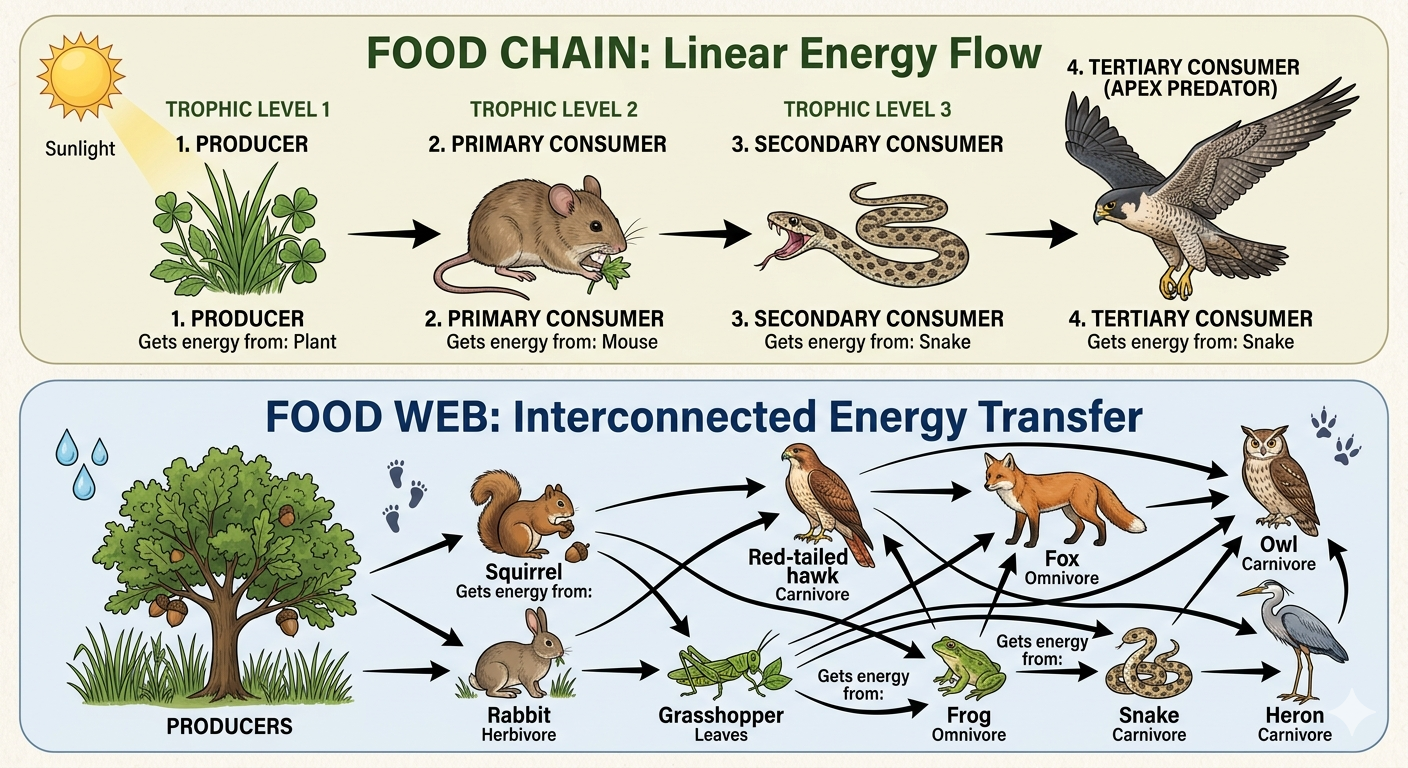
A food web shows how
food produce by plants is distributed to other parts of the plant.
an organism protects itself in its environment.
organisms depends on one for shelter.
food produced by green plants is distributed among organisms in a community.
66.
The structure which enables a fish to breate in water is
buccal cavity
gills
swim bladder
lungs
67.
The interaction in which one species benefits and other is neither harmed nor benefited is termed as ......
Mutualism
Parasitism
Communism
Commensalism
68.
In a food chain, secondary producers are ......
omnivores
herbivores
carnivores
decomposers
69.
...... is a community where living organisms interact among themselves and also with the surrounding physical environment.
Family
A universe
An ecosystem
A herd
70.
Many animals in the Arctic and high mountain regions have thick fur and layer of fat under their skin. What is the primary purpose of this adaptation?
To help them blend into the rocks.
To protect them from being eaten by predators.
To keep their bodies warm in cold, harsh conditions.
To allow them to swim faster.
71.
How does camouflage, such as a chameleon changing color or a desert fox blending with sand, help an animal survive?
It makes them faster.
It helps them stay warmer.
It helps them avoid predators or hide from prey.
It helps them find water.
72.
In a grasslands ecosystem, how do grazing animals like zebras survive in a place with little cover?
They burrow underground.
They live in large herds for protection.
They hibernate for most of the year.
They climb trees to escape predators.
73.
Which of the following is a structural adaptation that helps birds thrive in a mountainous environment?
Short, weak wings.
Long legs for running.
A streamlined body for powerful flight.
No feathers.
74.
What is the definition of an adaptation?
A change in weather patterns.
A characteristic that helps an animal survive and reproduce in its environment.
The process of moving to a new habitat.
The death of a species.
75.
Why do many desert animals, like the Fennec Fox, have very large ears?
To help them hear predators from miles away.
To help them dig for food.
To release body heat and stay cool.
To cover their eyes during sandstorms.
76.
Mountain goats and sheep have specialized hooves that allow them to climb steep, rocky slopes. This is an example of what?
Behavioral adaptation
Physical/Structural adaptation
Camouflage
Nocturnal behavior
77.
Which of the following adaptations is most useful for a predator living in a vast, open grassland?
Long legs for running to catch prey.
Small, stunted legs for hiding.
Webbed feet for swimming.
A thick, heavy shell.
78.
Desert animals, such as rats and snakes, often spend their days in deep, cool burrows and come out only at night. What type of adaptation is this?
Physical Adaptation
Structural Adaptation
Behavioral Adaptation
Reproductive Adaptation
79.
A camel has large, flat feet. How does this structural adaptation help it survive in a desert landform?
It helps them swim across rivers.
It allows them to walk on soft sand without sinking.
It helps them climb rocky mountains.
It keeps their feet warm during cold nights.
80.
Green plants have the ability to make their own food hence they are known as
producers.
parasites.
decomposers.
consumers.
81.
Which of the following human activities maintains the balance of nature?
Pollution
Deforestation
Afforestation
Mining
82.
The primary consumer is the
cassava.
rat.
hawk.
snake.
83.
The linear sequence of feeding relationship among living things is called
food web.
food chain.
producer.
ecology.


Digital Address: GZ-033-0057
King Kotey Road
Teshie - Accra
Ghana
+233 54 753 9118
info@kuulchat.com

© Copyright 2015 - 2026
All Rights Reserved