1.
The current in a resistor is 3A. If the resistance of the resistor is 4 ohms, determine the potential difference across the resistor.
0.75 V
1.33 V
7.00 V
12.00 V
2.
It is not advisable to use old electrical gadgets because they
are not efficient.
are dangerous.
produce sparks.
waste energy.
3.
Which of the following effects is not a result of illegal connection of electricity?
It can
lead to fire outbreak
lead to frequent power cut-off
increase the flow of current in the supply chain
cause damage to electrical appliance
4.
Which of the following electrical appliances can convert electrical energy to heat energy?
I. Electric iron
II. Kettle
III. Water heater
I, II and III
I and III only
II and III only
I and II only
5.
An electric bulb is rated 0.5 A, 120 V. Determine the power produced when the bulb is turned on.
60 kW
60 W
30 kW
30 W
6.
An electrical engineer was in your school to replace a 20 W bulb with a 50 W bulb.
Use this information to answer the question below
The unit inscribed on the bulb measures its
energy.
workdone.
power.
electricity.
7.
An electrical engineer was in your school to replace a 20 W bulb with a 50 W bulb.
Use this information to answer the question below
The 50 W bulb is likely to
I. increase the brightness in the room.
II. increase the amount of electricity consumed.
III. destroy the habitat of pests.
I, II and III
I and III only
II and III only
I and II only
8.
It is not advisable to use old electrical gadgets because they
are not efficient.
are dangerous.
produce sparks.
waste energy.
9.
Which of the following instruments is connected in parallel across a resistor in an electrical circuit?
Ammeter
Voltmeter
Ohmmeter
Galvanometer
10.
The instrument used to measure potential difference across a resistor is
ammeter.
barometer.
hydrometer.
voltmeter.
11.
The current flowing through a resistor of resistance 10 ohms is 2.5 A. What is the potential difference between the two terminals of the resistor?
4V
12.5 V
25 V
50 V
12.
Which of the following is used to measure the potential difference across a resistor in an electrical circuit?
A galvanometer
A rheostat
A meter bridge
A voltmeter
13.
Which of the following instruments is used in measuring current in an electric circuit?
Voltmeter
Ammeter
Barometer
Thermometer
14.
Calculate the voltage across a wire of resistance 4 ohms if 3 amperes of current is passed through it.
0.75 V
1.00 V
1.33 V
7.00 V
15.
The energy for lighting a torchlight bulb comes from the
bulb
cell
filament
glass
16.
The instrument used to measure current in an electric circuit is the
ammeter.
anemometer.
barometer.
thermometer.
17.
Which of the following substances can be used as an electrical insulator?
Copper
Graphite
Plastic
Zinc
18.
The figure below shows a simple electric circuit.
Use it to answer the question below.
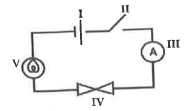
The switch is represented by
IV
III
II
I
19.
The figure below shows a simple electric circuit.
Use it to answer the question below.
The component labelled V is a/an
ammeter.
battery.
lamp.
voltmeter.
20.
The figure below shows a simple electric circuit.
Use it to answer the question below.
The purpose of the component labelled IV is to
supply energy to the circuit.
measure the voltage of the battery.
prevent too much current from flowing.
close the circuit.
21.
Use the diagrams below to answer the question below
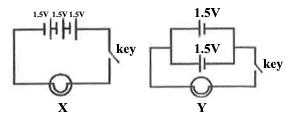
Which of the following statements is correct about the circuit diagrams above? The cells in diagram
X are in series and the key is open.
X are in parallel and the key is open.
Y are in series and the key is closed.
Y are in parallel and the key is closed.
22.
Use the diagrams below to answer the question below
The total emf of the cells in diagram Y is
4.50 V.
3.00 V.
1.50 V
0.75 V.
23.
A safety device which opens an electric circuit to prevent too much current from passing through the circuit is the
earth wire.
lightning conductor.
fuse.
switch.
24.
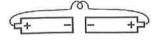
In which of the following circuit diagrams below will the bulb light?
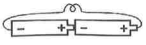
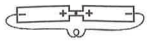
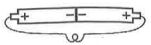
25.
A fuse is used in an electrical circuit to
measure the energy used up.
protect appliances.
provide more current.
make sure current flows continuously.
26.
A fuse is connected in an electric circuit to
prevent electric shock.
increase the current.
prevent current from increasing.
increase the heat generated.
27.
Which of the following conditions is not required for a current to flow through an electric circuit?
The circuit should be closed
A battery must be present
There must be connecting wires
A bulb must be connected in the circuit
28.
In electrical circuits, the component that protects appliances against high currents is the
capacitor.
fuse.
resistor.
switch.
29.
In modern electrical wirings the colour code for the live wire is
blue.
brown.
green.
green and yellow.
30.
Which of the following materials allows electric current to pass through easily?
Aluminium
Carbon
Glass
Water
31.
Which of the following effects is not a result of illegal connection of electricity?
It can
lead to fire outbreak
lead to frequent power cut-off
increase the flow of current in the supply chain
cause damage to electrical appliance
32.
The importance of fuse in an electrical circuit is to
regulate the voltage.
prevent damage to electrical appliances.
alter the flow of current in the circuit.
minimize the use of current.
33.
What is the colour of the neutral wire in a three-pin plug?
Blue
Brown
Green
Yellow
34.
A rheostat is used in an electric circuit in order to
increase electric current only.
decrease electric current only.
keep electric current constant.
increase and decrease electric current.
35.
The instrument used to measure current in an electric circuit is the
ammeter.
photometer.
thermometer.
voltmeter.
36.
The colour of the neutral wire in an electrical circuit is
blue.
brown.
green.
yellow.
37.
The unit of potential difference
ampere
watt
ohm
volt
38.
A 1500 W heater runs for 2 hours. How much energy does it consume?
1.5 kWh
2 kWh
3 kWh
4 kWh
39.
A 40 W light bulb is on for 25 seconds. How many Joules of energy does it use?
100 J
400 J
1000 J
10000 J
40.
Two resistors each 5 Ω are connected in parallel. Determine their effective resistance.
2.5 Ω
6.4 Ω
10.0 Ω
25.0 Ω
41.
A series circuit consists of three resistors with values of 12 Ω, 27 Ω, and 33 Ω. The total resistance is:
12 Ω
24 Ω
33 Ω
72 Ω


Digital Address: GZ-033-0057
King Kotey Road
Teshie - Accra
Ghana
+233 54 753 9118
info@kuulchat.com

© Copyright 2015 - 2026
All Rights Reserved