
Finwaver.com
Your school or business runs better on finwaver.com. Sign up for free one (1) week try.
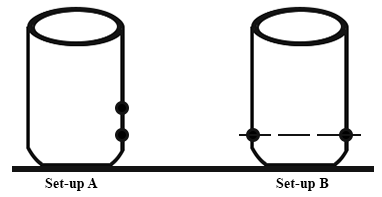
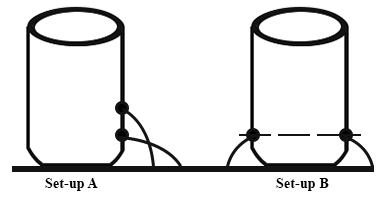
In an experiment, a pupil took two empty Milo tins and made holes in their sides as shown in the diagram above. The pupil then filled the Milo tins with water.
(i)
Draw and label the diagrams to show what the pupil will observe in set-up A and set-up B.
(ii)
Explain the observations in set-up A and set-up B.
(iii)
What is the aim of set-up A?
(iv)
What is the aim of set-up B?
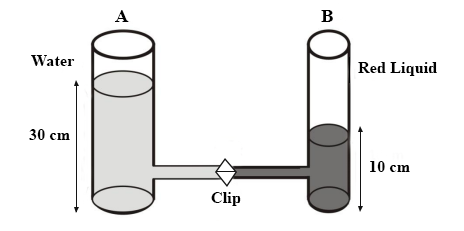
In an experiment, as in the set-up above, two glass containers A and B of different sizes are joined together with a tube and clipped.
Water is poured into container A to a height of 30 cm and a red liquid is poured into B to a height of 10 cm. The clip is then removed so that the liquids join together.
(i)
State two observations that will be made immediately the clip is removed.
(ii)
Explain the observations in (i).
(iii)
What two observations will be made after a long time? Explain.
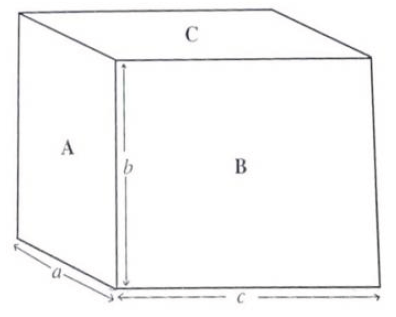
The diagram below is an illustration of a cuboid with faces A, B and C shown and sides a, b and c indicated.
Study the diagram carefully and answer the questions that follow.
i)
Measure and record the length of each of the sides labelled a, b and c in centimeters.
ii)
Determine the area of each of the faces A and B.
iii)
If the weight of the cuboid is 100N, determine the pressure exerted by the cuboid in N/cm2 when it lie on
α)
face A;
β)
face B.
iv)
From your results in (iii), explain how pressure exerted by a body changes with the area on which it lie.


Digital Address: GZ-033-0057
King Kotey Road
Teshie - Accra
Ghana
+233 54 753 9118
info@kuulchat.com

© Copyright 2015 - 2026
All Rights Reserved