
Finwaver.com
Your school or business runs better on finwaver.com. Sign up for free one (1) week try.
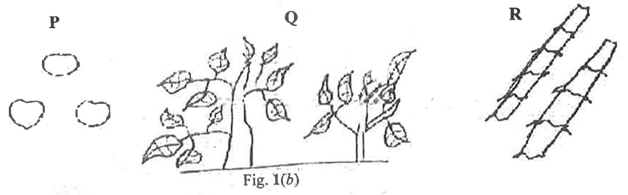
Fig. 1(b) is an illustration of three sets of plant parts labelled P(maize grains), Q(tomato seedlings) and R(cassava cutting).
Study it carefully and answer the questions that follow
(i)
Describe briefly how each of the parts labelled P, Q and R are planted on seedbed.
(ii)
State four conditions under which R can be cultivated to produce high yield.
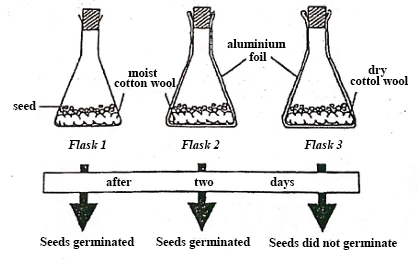
The diagrams below are illustrations of a set-up used to study the conditions for seed germination. The flasks are kept at 25 oC during the experiment. Study the diagrams carefully and answer the questions that follow.
(i)
What conclusion can be drawn from the results of flask 1 and flask 2?
(ii)
What conclusion can be drawn from the results of flask 2 and flask 3?
(iii)
The seedings in flask 2 died after two weeks. What can be the reasons for this occurrence?
(iv)
A candidate concluded that light was an important factor for the germination. Did the candidate make a correct conclusion?
(v)
Give a reason for the answer stated in (iv) and state which of the flasks in the experiment could be used to support your answer.
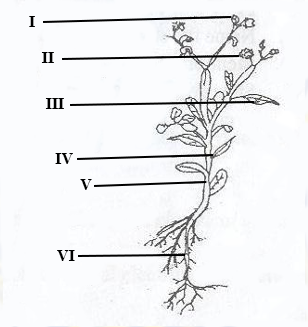
The diagram below is an illustration of the external features of a flowering plant.
Study it carefully and use it to answer the questions that follow.
i)
Name the parts labelled I, II, III, IV, V and VI.
ii)
State one function of each of the parts labelled I, II, III, V and VI.
iii)
State the two main parts of a flowering plant.


Digital Address: GZ-033-0057
King Kotey Road
Teshie - Accra
Ghana
+233 54 753 9118
info@kuulchat.com

© Copyright 2015 - 2026
All Rights Reserved