Finwaver.com
Your school or business runs better on finwaver.com. Sign up for free one (1) week try.
1.
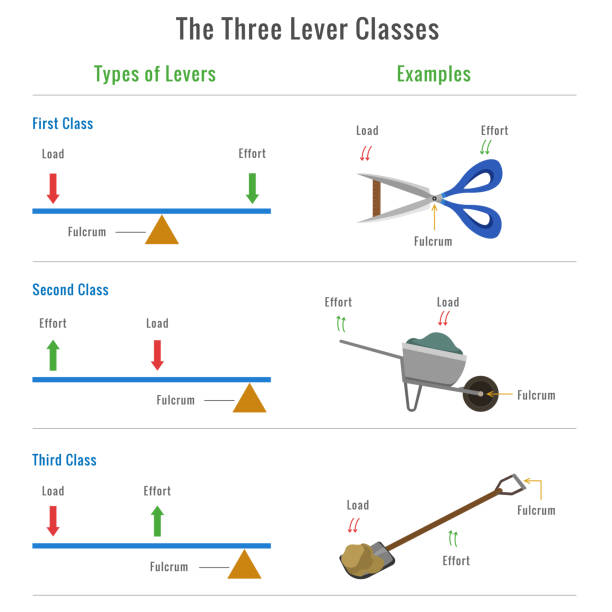
An example of a first class lever is
bottle opener.
crow bar.
wheel barrow.
fishing rod.
2.
An example of a first class lever is
bottle opener.
crow bar.
wheel barrow.
fishing rod.
3.
A machine lifts a load of 100 N through a vertical distance of 2 m in 10s.
What is the work done by the machine?
50 J
100 J
200 J
400 J
4.
A machine lifts a load of 100 N through a vertical distance of 2 m in 10s.
What is the power of the machine?
50 W
20 W
10 W
2 W
5.
Which of the following machines are complex machines?
I. Tractor
II. Mist blower
III. Sewing machine
I and II only
I and III only
II and III only
I, II and III
6.
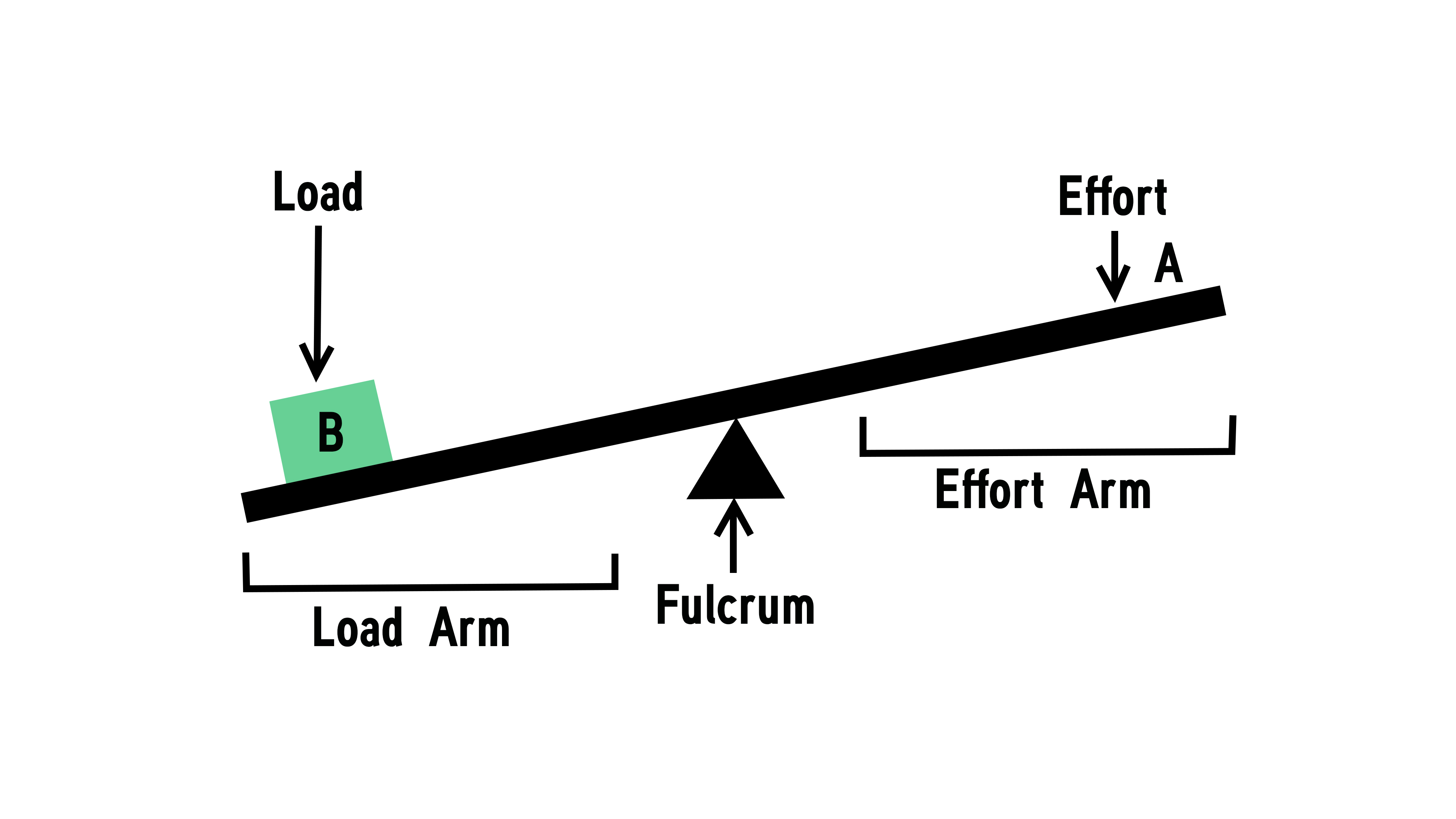
Which of the following is true about a first class lever?
The load is between the effort and the pivot
The pivot is between the effort and the load
The effort is between the pivot and the load
The load is on the pivot
7.
In which of the following situations is work not done? When a
truck moves
wheelbarrow is pushed
fruit falls from a tree
football is kicked
8.
What is the work done when a force of 2.5 N moves through a distance of 4 m?
0.6 J
1.5 J
1.6 J
6.5 J
9.
The work done when a weight of 40 N is lifted up vertically through a distance of 10 m is
400 J
50 J
30 J
4 J
10.
Which of the following explains why no work is done when a push is made against a firm wall?
The force acts in the opposite direction
The wall does not move
The force is in the same direction
The material of the wall is strong
11.
In a simple machine, the force that is applied to enable work to be done is known as
Lever
Load
Pivot
Effort
12.
The fixed point of a lever at which turning takes place is the
pivot
effort
load
handle
13.
14.
Which of the following conditions in a simple machine will make working difficult? When
The load distance is equal to the effort distance
The effort distance is twice the load distance
The effort distance is three times the load distance
Small effort moves through a longer distance
15.
In what units are work and energy measured?
work in joules, energy in watts
work in joules, energy in joules
work in newtons, energy in joules
energy in watts, work in watts
16.
In a first class lever, the load is placed
on the effort
between the effort arm and the pivot
at one end of the load arm
between the pivot and the load arm
17.
Power is defined as the
ability to do work
amount of energy
rate of distance covered
rate of doing work
18.
What is the work done when a girl lifts a pot of water weighing 40 N upward through a distance of 1 m?
400.0 J
40.0 J
4.0 J
1.0 J
19.
A boy exerts a force of 40.0 N to lift a load into a vehicle. If the work done is 80.0 J, calculate the distance through which the load is lifted.
0.5 m
2.0 m
40.0 m
120.0 m
20.
The force overcome by a machine is known as the
effort
load
pivot
lever
21.
Calculate the work done when a weight of 20.0 N is lifted vertically through a distance of 10.0 cm
2000.0 J
200.0 J
20.0 J
2.0 J
22.
67%
40%
33%
30%
23.
How much work is done when a kerosene tin is pushed with a force of 20 N through a distance of 2 m?
0.01 J
0.10 J
10.0 J
20.0 J
24.
25.
An object weighing 60 N is dragged through a distance of 2 m. Calculate the work done
6 J
15 J
30 J
120 J
26.
The efficiency of a machine is usually less than one due to
friction
greasing
heat
the load used
27.
The efficiency of a machine is given by the ratio
28.
The stretched arm of a JSS student holding a stone in the palm is an example of a
First class lever
Second class lever
Third class lever
Fourth class lever
29.
Which of the following statements about machines is/are true?
I. The commonest and simplest of all machines is the lever
II. The efficiency of a machine is the ratio of work output to work input
III. The efficiency of a machine is usually less than one
IV. Machines make working much easier and convenient
I only
I and II only
I and III only
I, II and III only
30.
Use the figure below to answer the question below.
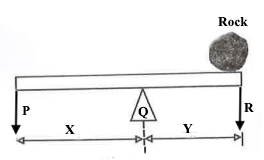
A rigid bar is balanced horizontally at a point by placing a rock on the bar as shown.
Which of the parts labelled represents the pivot?
P
Q
R
X
31.
Use the figure below to answer the question below.
A rigid bar is balanced horizontally at a point by placing a rock on the bar as shown.
The effort is represented by
P
Q
R
X
32.
Which of the following statements about machines is/are correct?
I. Machines help us to do work more easily
II. A force applied at one point of the machine overcomes a load at another point of the machine
III. All machines have engines
I only
II only
III only
I and II only
33.
A man applied a force of 50 N to push a wheelbarrow through a distance of 6 m. Calculate the work done.
300 J
56 J
44 J
30 J
34.
In which of the following situations is work said to be done?
Walking with a load on the head in an upright position
Getting up from a chair
Pushing against a wall which does not move
Sitting still behind a desk
35.
A machine which has an energy loss of 10% will have an efficiency of
100%
90%
55%
10%
36.
Which of the following conditions describes a first class lever?
The load is between the effort and pivot
The pivot is between the effort and the load
The effort is between the pivot and the load
The load arm is equal to the effort arm
37.
A man did 75 J of work by lifting a 50 N load from the floor on to a shelf. Calculate the height of the shelf.
0.67 m
1.50 m
25.00 m
125.00 m
38.
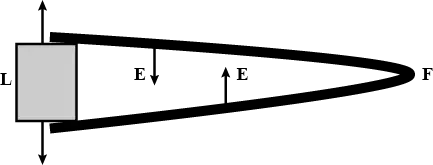
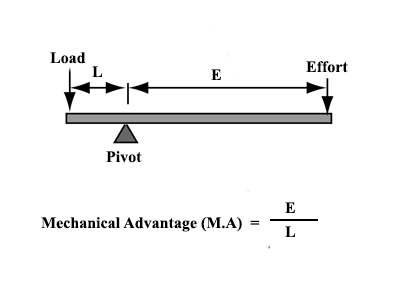
It is easier to move a heavy load with a crowbar when the
effort distance is shorter than the load distance.
effort distance is longer than the load distance.
effort distance is equal to the load distance.
effort is equal to the load.
39.
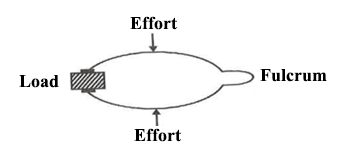
The type of lever shown above is a
first class lever.
second class lever.
third class lever.
combination of first and second class levers.
40.
The work done when a force moves a body through a distance of 12 m is 720 J. The force applied is
8640 N
732 N
708 N
60 N
41.
A force of 2N moves a body through a distance of 10 m. Calculate the work done.
5 J
8 J
12 J
20 J
42.
The diagram below shows a lever system used to move a stone. Use it to answer the question below
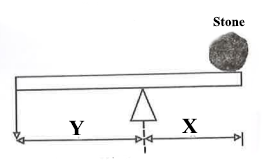
The distance X is the
effort distance.
load distance.
fulcrum.
lever arm.
43.
The diagram below shows a lever system used to move a stone. Use it to answer the question below
Less effort is required to move the stone when the
distance Y is equal to X.
distance Y is greater than X.
distance Y is less than X.
stone is at the pivot.
44.
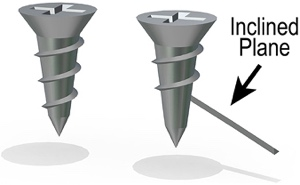
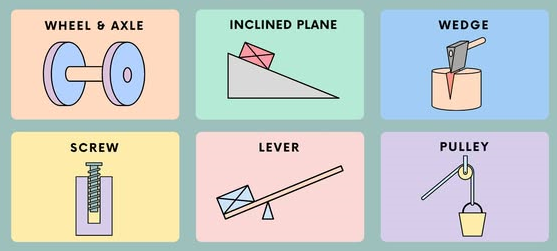
A screw is a machine which works in the same way as
a lever.
an incline plane.
a wheel and axle.
a pulley.
45.
Power is defined as the rate at which
energy is used.
temperature rises.
a body travels.
a body cools down.
46.
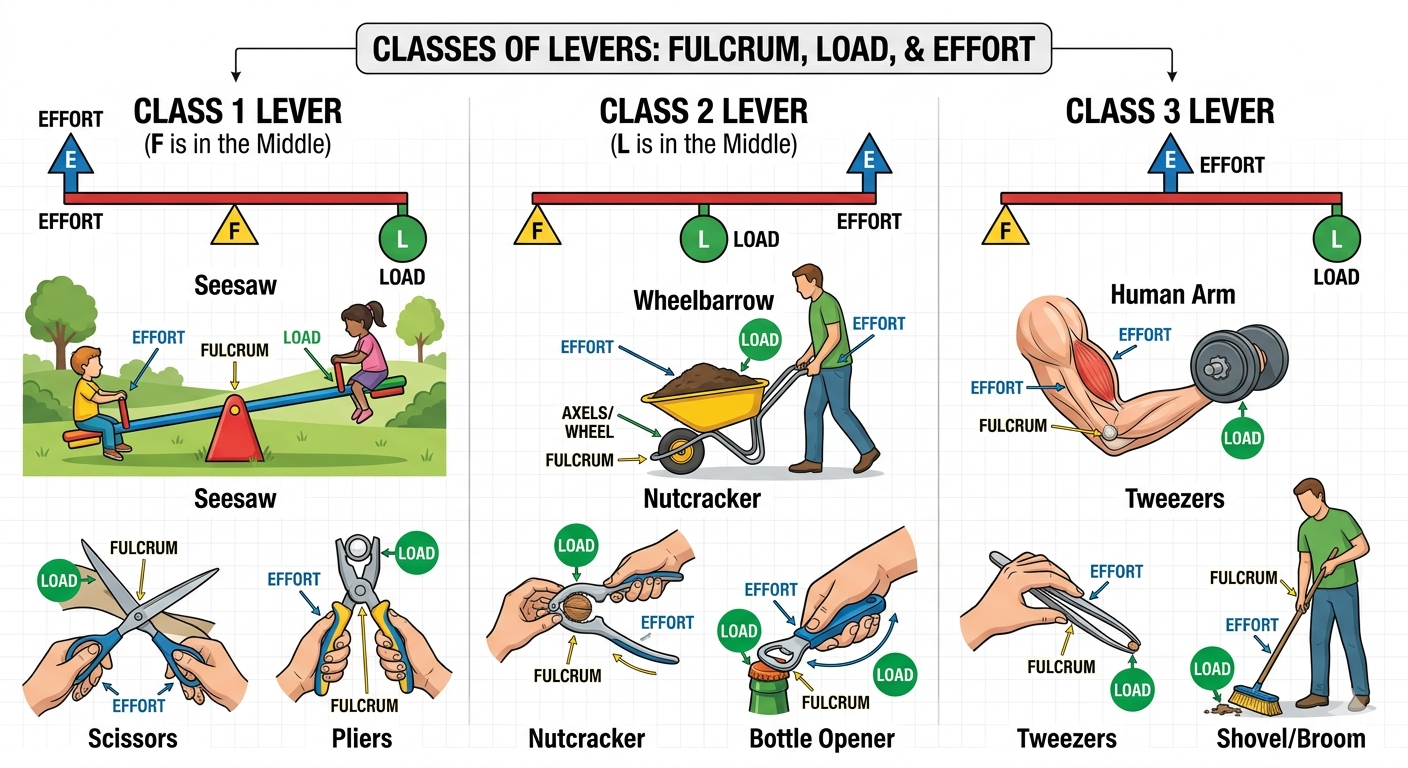
An example of a lever in which the effort is applied at the middle is a
wheelbarrow.
pair of forceps.
pair of scissors.
beam balance.
47.
A simple way of maintaining the efficiency of a machine is by
oiling its parts.
fitting new parts on the machine.
making sure it is always working.
making sure it works at low speed.
48.
The human forearm is an example of
a first class lever.
a second class lever.
a third class lever.
both first and third class levers.
49.
In a third-class lever the
pivot is between the load and effort
pivot is absent
load is between the effort and pivot
effort is between the load and pivot
50.
At which positions S,R,Q and P on the lever in the diagram below must a force be applied to lift the load most easily?
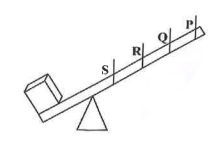
P
Q
R
S
51.
Which of the following machines works on the same principle as an inclined plane?
Bottle opener
Wheelbarrow
See-saw
Screw
52.
Power is defined as the
ability to do work.
force to move an object.
rate of doing work.
ability to replace energy used.
53.
A load of 10 N is moved through a distance of 2 m. Calculate the work done.
5 J
10 J
20 J
50 J
54.
One function of engine oil in the engine of a tractor is to
warm the engine.
enhance air intake.
ensure proper mixing of fuel.
lubricate the engine parts.
55.
The efficiency of a machine is always less than 100% because part of the energy input is used to
stop the machine after working.
perform useful work of the load.
overcome friction.
lift the machine up.
56.
A rigid bar which is capable of turning about a fixed point is a/an
inclined plane.
lever.
screw.
wheel and axle.
57.
Which of the following statements about a second class lever is correct? The
pivot is between the load and the effort.
pivot and the load are at the same position.
load is between the effort and the pivot.
effort is between the load and the pivot.
58.
Energy is the
force to move an object.
weight of the body.
ability to do work.
power to carry an object.
59.
An example of a third class lever is
wheelbarrow.
sugar tongs.
pair of scissors.
crowbar.
60.
Which of the following simple machine is a second class lever?
Bottle top opener
Claw hammer
Fishing rod
Pair of pliers
61.
In all machines, the efficiency is
always 100%
less than 100%
more than 100%
always 0%
62.
It is easier to move a heavy load with a crowbar when the
effort distance is shorter than the load distance.
effort distance is longer than the load distance.
effort distance is equal to the load distance.
effort is equal to the load.
63.
The work done when a force moves a body through a distance of 12 m is 720 J. The force applied is
8640 N.
732 N.
708 N.
60 N.
64.
The work done by force of 20 N on a body is 60 J. Calculate the distance through which the force moved
8.0 m
4.0 m
3.0 m
2.0 m
65.
The energy output of a system is 40 J and the efficiency is 50%. Determine the energy input of the system.
50.0 J
80.0 J
24.0 J
75.0 J
66.
An example of a simple lever which has its effort at the centre is
a bottle opener.
a pair of scissors.
the beam balance.
a pair of forceps.
67.
An example of an inclined plane is a
flat road surface.
see-saw.
pulley.
path of a hill.


Digital Address: GZ-033-0057
King Kotey Road
Teshie - Accra
Ghana
+233 54 753 9118
info@kuulchat.com

© Copyright 2015 - 2026
All Rights Reserved