Finwaver.com
Your school or business runs better on finwaver.com. Sign up for free one (1) week try.
The diagrams below are illustrations of an experiment in the laboratory using a piece of stone, a cork of mass 4.0 g and other necessary materials.
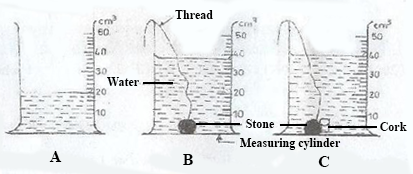
The initial volume of water in A was read and noted. A string was attached to a piece of stone and the stone lowered gently into the water as shown in B. The volume was again read and noted. Finally, the cork of mass 4.0 g was attached to the stone and both materials lowered gently into the water as shown in C. The volume was read and noted.
i)
Why did the level of the water rise when the stone was lowered gently into it as shown in diagram B.
ii)
Why was it necessary to attach the stone to the cork before lowering it gently into the water as shown in diagram C?
iii)
What would have happened if the cork alone were lowered gently into the water?
iv)
What is the volume of the
α)
stone?
β)
cork?
v)
Calculate the density of the cork.
vi)
Why were the materials lowered gently in to the water?
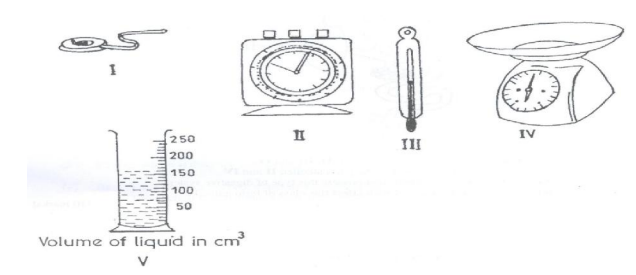
The diagrams below show some instruments used in the laboratory.
Study the diagrams carefully and answer the questions that follow.
(i)
Identify each of the instruments labelled I, II, III, IV and V.
(ii)
State one use of each of the instruments labelled I, II, III and IV.
(iii)
Read and record the volume of the liquid in the instrument labelled V.
The diagram below is an illustration of an experiment carried out in the laboratory.
Study the diagram carefully and answer the questions that follow.
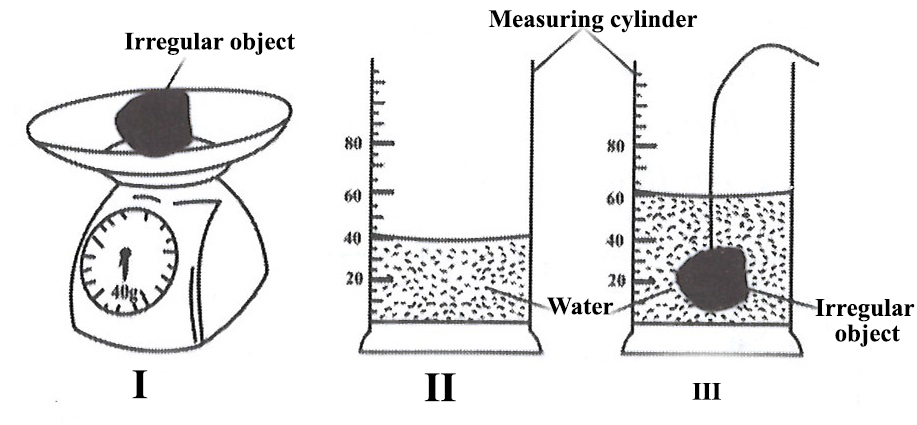
i)
Read and record the:
(α) mass of irregular object (M) in I
(β) Volume of water (V1) in II
(γ) Volume of water (V2) in III
ii)
Determine the volume of the irregular object.
iii)
Calculate the density of the irregular object.
iv)
Name the instrument that could be used to measure the mass of an irregular object.
v)
State one precaution to be taken in performing the experiment.


Digital Address: GZ-033-0057
King Kotey Road
Teshie - Accra
Ghana
+233 54 753 9118
info@kuulchat.com

© Copyright 2015 - 2026
All Rights Reserved