
Finwaver.com
Your school or business runs better on finwaver.com. Sign up for free one (1) week try.
i)
Name two fundamental units of measurement.
ii)
State the physical quantity that one of the units named in (i) measures.
A piece of stone has a mass of 36.0 g. When it is put into water in a glass container, the level of water rises from 60.0 cm3 to 90.0 cm3.
(i)
Calculate the density of the stone.
(ii)
Explain what will be observed when the stone is put into another liquid of density 1.4 gcm-3?
What instrument would you use to measure each of the following quantities:
(i)
volume of a liquid
(ii)
mass of a stone
(iii)
time
(iv)
speed of the wind?
In an experiment to determine the density, a stone of mass 60 g is put into a bowl containing water. If the level of the water rises from 60 cm3 to 75 cm3, determine the density of the stone.
(i)
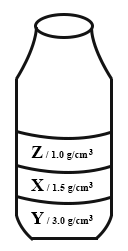
Three insoluble liquids X, Y and Z are shaken together in a bottle and allowed to settle.
The densities of the liquids are as follows:
X = 1.5 g/cm3
Y = 3.0 g/cm3
Z = 1.0 g/cm3
Draw a sketch to show the various layers into which the liquids settle.
(ii)
The density of petrol is 0.9 g/cm3.
Calculate the volume of 300 g of petrol.
i)
Define density of a substance.
ii)
Explain how a body which sinks in water could be made to float.
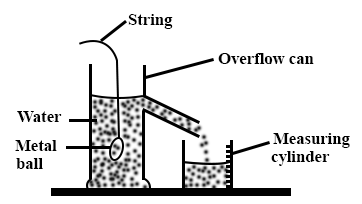
Describe briefly how the volume of an irregular shaped metal ball could be determined
i)
Define the term density
ii)
Describe briefly how the density of a piece of stone could be determined
An object of mass 150 g occupies a volume of 250 cm3. Calculate its density.
(i)
Define density of a substance
(ii)
Describe briefly how you would determine the density of an irregular piece of stone.
(iii)
A box with volume 1200.0 m3 is filled with sand to the brim. If the density of the sand is 1.95 kgm-3, calculate the mass of the sand contained in the box.
State the units in which each of the following are measured:
(i)
Power
(ii)
Energy
(iii)
Electric current
(iv)
Temperature
Give two differences between the mass and weight of a body.
A box with a volume of 1000 m3 is filled with sand to the brim. If the density of sand is 2 kgm-3, calculate the mass of sand in the box.
(i)
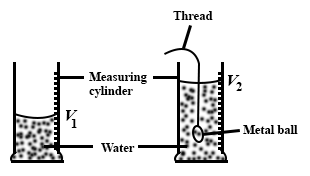
A student seeking to determine the volume of an irregular body of mass 4 kg used a graduated cylinder in an experiment.
Fig. 2 illustrates two key stages of the experiment where A indicates a setup before the irregular body was immersed and B indicates the same setup after the irregular body was immersed.
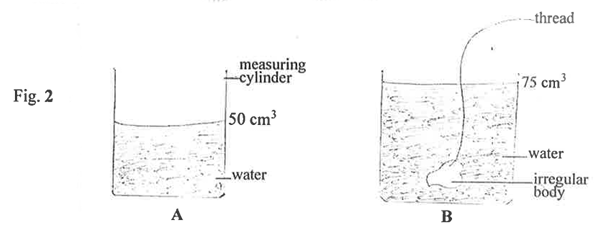
Determine the density of the irregular body.
(ii)
State two precautions that must be taken to obtain reliable results.
(i)
What is a physical quantity?
(ii)
State two physical quantities
(i)
Define density of a substance.
(ii)
Describe how you would determine the density of a sample of soil in the laboratory.
A body of mass 50kg has a density of 2kg/m3. Calculate the volume of the body.
Name the instrument used in measuring the following:
i)
Length of a rope;
ii)
Mass of a stone;
iii)
Temperature of a liquid;
iv)
Volume of a liquid.
i)
What are derived quantities?
ii)
State the S.I units of the following quantities:
α)
area;
β)
volume.
i)
What is mass?
ii)
A box of equal size 3cm has a density of 2.0gcm-3.What is its mass?


Digital Address: GZ-033-0057
King Kotey Road
Teshie - Accra
Ghana
+233 54 753 9118
info@kuulchat.com

© Copyright 2015 - 2026
All Rights Reserved