
Finwaver.com
Your school or business runs better on finwaver.com. Sign up for free one (1) week try.
1.
Solid non-metals normally break into pieces when hammered because they are
brittle
ductile
lustrous
malleable
2.
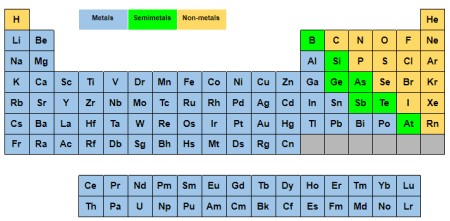
Which of the following elements is a semi-metal?
Carbon
Nitrogen
Silicon
Sodium
3.
Steel is an alloy of iron and
aluminum
carbon
silicon
gold
4.
In making ornaments and jewellery, non-reactive metals are preferred because they
are corrosive.
are attractive.
do not retain their lustre.
do not react with atmospheric oxygen.
5.
A metallic saddle was left in a boiling soup. After sometime, the handle became hot.
This is because the particles in the saddle
undergo rapid, random motion,
contain free electrons which are able to transfer heat energy.
are separated by large distances.
circulate as a result of the temperature differences.
6.
Which of the following methods can be used to prevent iron from rusting?
I. Painting
II. Alloying
III. Keeping the iron in a desiccator
IV. Keeping iron in a moist environment
I and II only
II and IV only
I, II and III only
II, III and IV only
7.
Which of the following is a liquid?
Iron
Mercury
Brass
Gold
8.
All the following are solids except
aluminium
lead
silver
potassium
9.
Which of the following metals is used for making roofing sheets?
Zinc
Silver
Mercury
Tin
10.
A uniform mixture of two or more metals is called
a solute
a colloid
a compound
a suspension
11.
12.
Which of the following has a different physical state from the others under ordinary conditions?
Zinc
Lead
Iron
Mercury
13.
Brass is an alloy made up of
Aluminium and zinc
Copper and tin
Copper and zinc
Iron and carbon
14.
Which of the following metals is an alloy?
Aluminium
Brass
Copper
Iron
15.
Brass is an alloy of copper and
aluminium.
carbon.
iron.
tin.
16.
A uniform mixture of two or more metals is called
an alloy.
a coiled.
an aerosol.
a compound
17.
Gold is usually used to make jewellery because it is
precious.
expensive.
less reactive with air.
a good conductor of heat.
18.
Which of the following substances is a non-metal?
Diamond
Mercury
Sodium
Steel
19.
Which of the following elements is a metal?
Carbon
Nitrogen
Sulphur
Sodium
20.
Metals that are usually used to make ornaments have low
conductivity.
ductility.
malleability.
reactivity.
21.
Which of the following gases is involved in the process of rusting?
H2
Co2
O2
N2
22.
A non-reactive metal can be identified from other metals because its surface is
hard.
shiny.
smooth.
rough.
23.
The property of a metal that makes it possible for it to be drawn into a wire is called
conductivity.
ductility.
malleability.
resistivity.
24.
Steel is an alloy of
iron and carbon.
zinc and copper.
iron and zinc.
brass and zinc.
25.
The property of a metal that makes it possible for it to be beaten into different shapes is called
conductivity.
ductility.
malleability.
resistivity.
26.
Metals are able to conduct electricity because they possess
free electrons.
neutrons.
atoms.
free protons.
27.
The property of a metal that makes it possible for it to be drawn into a wire is called
conductivity.
ductility.
malleability.
resistivity.
28.
Bronze is an alloy of
iron and carbon.
zinc and copper.
iron and zinc.
copper and tin.
29.
Which of the following gases helps in rusting?
Carbon dioxide
Hydrogen
Oxygen
Nitrogen
30.
An example of a semimetal is
calcium.
lithium.
silicon.
sodium.
31.
Which of the following chemical symbols is that of a metal?
Ca
Ne
P
S
32.
Non-reactive metals are preferred in making ornaments and jewellery because they
are attractive.
do not react with atmospheric oxygen.
do not retain their luster.
are corrosive.
33.
Which of the following methods protects pure iron from rusting by coating with zinc?
Alloying
Galvanizing
Greasing
Painting
34.
Which of the following effects are caused by rusting?
I. Loss of strength
II. Loss of structure
III. Loss of electrical conductivity
I and II only
I and III only
II and III only
I, II and III
35.
The property of metals which makes them to be easily drawn into thin wires is known as
conductivity.
ductility.
malleability.
resistivity.
36.
Solid non-metals normally break into pieces when hammered because they are
brittle
ductile
lustrous
malleable
37.
Which of the following elements is a semi-metal?
Carbon
Nitrogen
Silicon
Sodium
38.
Steel is an alloy of iron and
aluminum
carbon
silicon
gold
39.
Brass is an alloy of
iron and carbon
zinc and copper
iron and copper
copper and tin
40.
Which of the following conditions promote(s) rusting of iron?
I. Air
II. Moisture
III. Oil
I only
II only
I and II only
II and III only
41.
One difference between metals and non-metals is that metals
have low density.
are not malleable.
have lustre.
have low melting points.
42.
Which of the following substances can rust?
Aluminium
Bauxite
Copper
Steel
43.
Steel is an alloy of iron and
aluminium.
carbon.
silicon.
gold.
44.
An example of a semi-metal is
silicon
carbon
beryllium
D. argon


Digital Address: GZ-033-0057
King Kotey Road
Teshie - Accra
Ghana
+233 54 753 9118
info@kuulchat.com

© Copyright 2015 - 2026
All Rights Reserved