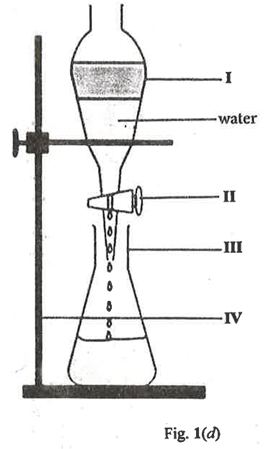
Fig. 1(d) illustrates an experiment performed to separate the components of a mixture.
Study it carefully and answer the questions that follow
(i)
Describe briefly the process of this experiment.
(ii)
State one function for each of the parts labelled II and IV.
(iii)
State two precautions that should be taken to obtain reliable results when performing this experiment.
The following activities were carried out in the laboratory.
Study them carefully and answer the questions that follow.
I.
10 g of iodated salt was added to 150 ml of water in a baker. The mixture was stirred thoroughly.
II.
Vegetable oil was added to a quantity of water in a corked flask and shaken vigorously then allowed to stand for some time.
III.
Few grams of grinded charcoal was added to water in a beaker and stirred vigorously and then allowed to stand.
i)
State what will be observed in each of the activities I, II and III.
ii)
Suggest an aim for the experiment.
iii)
State one difference between what is observed in I and III.
iv)
State a method of separation for the activity carried out in II.
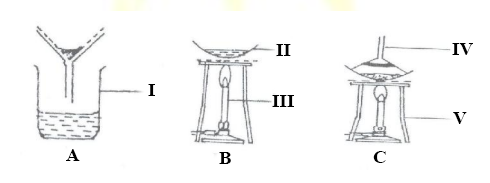
The diagrams below are different laboratory set-ups used in the separation of mixtures.
Study the diagrams carefully and answer the questions that follow.
(i)
Name each of the parts labelled I, II, III, IV and V.
(ii)
Name the separation method represented by each diagram.
(iii)
Which of the set-ups is used to obtain clear water from muddy water?
(iv)
Which of the set-ups is used to obtain salt from salt solution?
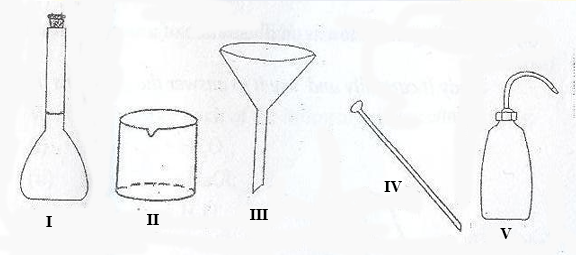
A salt solution was prepared in the laboratory using the set of apparatus illustrated below. Study the illustrations carefully and used them to answer the question that follow.
i)
Name each of the apparatus labelled I, II, III, IV and V.
ii)
State one function of each of the apparatus labelled I, II, III, IV and V.
The diagrams below are illustrations of an experimental set-up.
Study the diagrams carefully and answer the questions that follow.
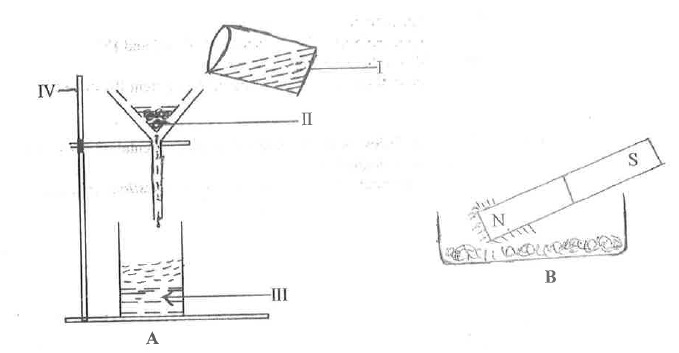
(i)
Identify each of the parts labelled I, II and III.
(ii)
Name the method of separation in each of the set-up:
Α
A;
Β
B.
(iii)
State the class of mixtures that the experimental set-up A could be used for.
(iv)
Give a reason for the answer stated in (iii).
(v)
Name one possible component of the mixture in set-up B.
(vi)
State the function of the part labelled IV.
The diagram below is an illustration of an experimental set-up used for separating a mixture of water and alcohol. Study the diagram carefully and answer the questions that follow.
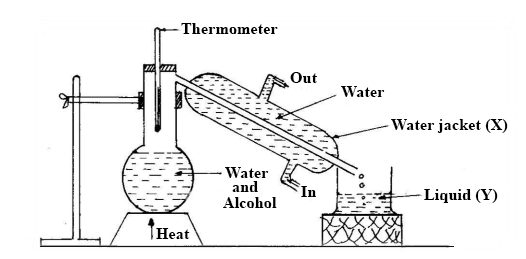
(i)
State the method of separation shown in the set-up.
(ii)
Identify liquid Y, with reasons.
(iii)
Give the functions of the thermometer and the water jacket X
(iv)
What physical processes are involved in the method of separating the mixture?
(v)
State the physical property which makes it possible to separate the water and alcohol.
The diagram below is an illustration of an experimental set-up used to separate water and salt from salt solution.
Study the diagram carefully and answer the questions that follow.
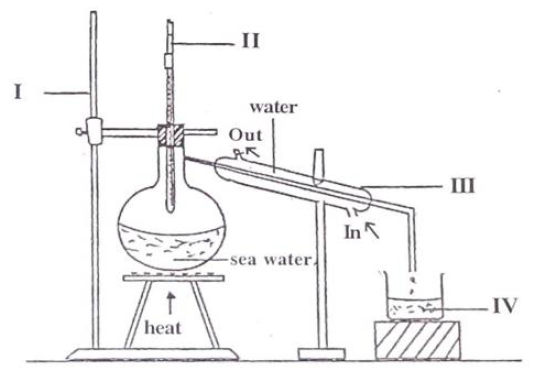
i)
Name each of the parts labelled I, II, III and IV.
ii)
Name the method of separation used.
iii)
State one function of each of the parts labelled II and III.
iv)
Name three physical processes that are involved in the separation of the mixture.
The diagram below is an illustration of an experiment performed to separate the components of muddy water.
Study the diagram carefully and answer the questions that follow.
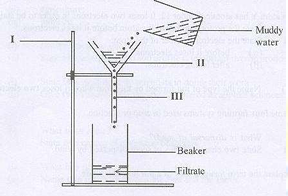
i)
Name each of the parts labelled I, II and III.
ii)
State the function of the part labelled II.
iii)
Name the substance obtained as the filtrate.
iv)
State three physical properties of the filtrate.
v)
Name two other materials that could be used in place of the part labelled II.


Digital Address: GZ-033-0057
King Kotey Road
Teshie - Accra
Ghana
+233 54 753 9118
info@kuulchat.com

© Copyright 2015 - 2026
All Rights Reserved