
Finwaver.com
Your school or business runs better on finwaver.com. Sign up for free one (1) week try.
1.
When equal amount of water is poured on dry soil samples, the increase in weight per unit amount of soil would be highest in
gravel.
clayey soil.
sandy soil.
loamy soil.
2.
Soil texture is a term used to describe the
amount of water soil can hold.
arrangement of soil particles in a given soil.
properties of soil, silt and clay in a sample of soil.
mixture of all soil particles.
3.
Which of the following statements about clayey soil is not true? It
swells when dry and shrinks when wet.
has high water retention.
is difficult to plough when dry
is compact when dry.
4.
The study of the soil profile of an area helps the farmer to
control weed growth
determine the soil temperature
determine the types of crop to grow
know the pesticides to use
5.
Soil texture is a term used to describe the
amount of water soil can hold.
arrangement of soil particles in a given soil.
properties of soil, silt and clay in a sample of soil.
mixture of all soil particles.
6.
Which of the following statements about clayey soil is not true? It
swells when dry and shrinks when wet.
has high water retention.
is difficult to plough when dry
is compact when dry.
7.
The proper way of maintaining soil structure and fertility is termed as soil
conservation
depletion
profile
erosion
8.
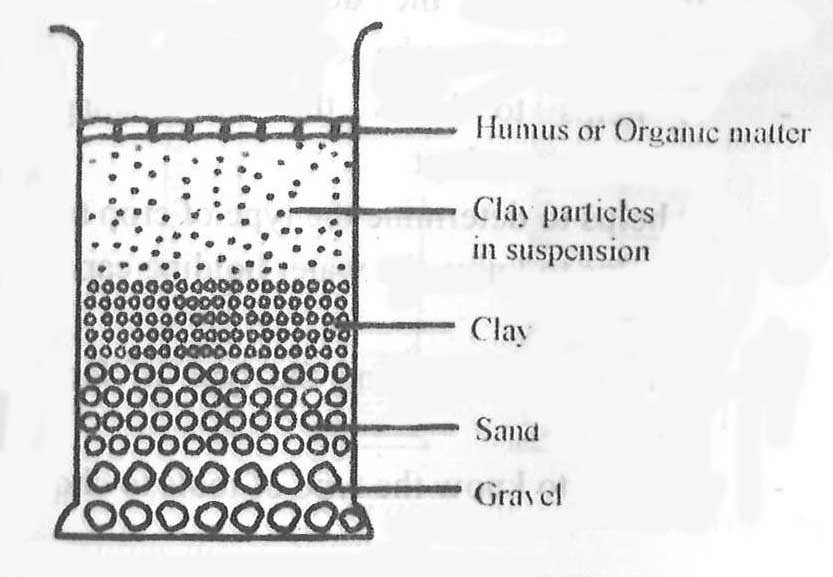
In an experiment to determine the various particle sizes of soil sedimentation, the particle above clay suspension are
Loam
Organic
Gravels
Silt
9.
If a soil is smooth and sticky, it means that the soil has a large amount of
Clay
Loam
Sand
Silt
10.
Which of the following soils is likely to be found in a waterlogged area?
Sand
Clay
Gravel
Black soil
11.
Which of the following soil organisms improve soil fertility?
Ant-lion
Red ant
Millipede
Snail
12.
Which of the following soil types can hold the least amount of water?
Loam
Clay
Silt
Sand
13.
Which of the following types of soil allows the fastest rate of drainage?
Clayey soil
Loamy soil
Black soil
Sandy soil
14.
Which of the following is the organic part of the soil?
Mineral salts
Water
Rock particles
Air
15.
When living organisms die, the mineral salts in their bodies become available to the soil through the process of
evaporation
sedimentation
defecation
decay
16.
Which of the following are soil micro-organisms?
Termites
Viruses
Ticks
Bacteria
17.
Soil aeration can be improved by
Adding mineral to the soil
Application of fertilizer to the soil
Weathering
Activities of earthworms
18.
Which of the following is true about loamy soil?
I. Is formed from a mixture of sand and clay
II. It is good for plant cultivation
III. Its water retention is poor
I only
I and II only
I and III only
II and III only
19.
Soil acidity can be reduced by adding
acid solution
ammonium sulphate
fertilizer
lime
20.
The most productive soil in agriculture is
clayey soil
loamy soil
sandy soil
humus
21.
Decay is an important biological process because it brings about the
formation of nutrients in living organisms
manufacture of cells of living organisms
production of oxygen by plants
release of nutrients from dead organisms
22.
Which of the following organs help to improve soil fertility?
Earthworms
Guinea worms
Hookworms
Roundworms
23.
Which of the following types of soil is good for plant growth?
Clay
Course sand
Fine sand
Loam
24.
The breakdown of rocks into smaller particles is known as
decomposition
erosion
ploughing
terracing
25.
The mineral salts in dead organisms become available to the soil through
Decomposition
Diffusion
Fermentation
Leaching
26.
The organic constituent of the soil is
Air
Humus
Mineral salts
Rock particles
27.
Clayey soil holds more water than any other type of soil because it has
large particle size.
large air spaces.
irregular particle size.
greater attraction for water.
28.
The best soil for plant growth consists of correct proportion of
clay, gravel and sand.
clay and humus.
clay, humus and sand.
clay and sand.
29.
The component of the soil which is made up of the finest particle is
clay.
humus.
loam.
sand.
30.
The soil type which is able to retain the highest amount of water is
loam.
gravel.
sand.
31.
The formation of humus is aided by
earthworms.
insects.
rats.
wind.
32.
Which of the following substances is added to the soil to reduce its acidity?
Charcoal
Humus
Lime
Manure
33.
The figure below shows the arrangement of parts of the soil when some soil sample was shaken with water in a glass cylinder and allowed to settle.
Use it to answer the question below.
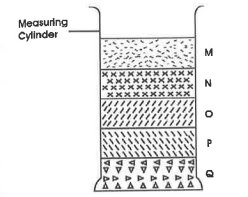
Which of the labelled layers contains organic matter?
M
N
O
P
34.
The figure below shows the arrangement of parts of the soil when some soil sample was shaken with water in a glass cylinder and allowed to settle.
Use it to answer the question below.
The layer which does not have the ability to retain much water is
N
O
P
Q
35.
Water drains faster through sand than clay because
sand particles are rougher.
sand contains more air spaces.
clay particles are smoother.
clay particles are bigger.
36.
The process whereby soil is formed by the breakdown of rocks is called
composting.
erosion.
leaching.
weathering.
37.
The part of the soil that supports plant growth is that part which
dissolves in water.
retains less water.
contains the humus.
is closer to the roots.
38.
Plants do not grow well in gravel because the
air spaces are too big to hold water.
air spaces are too small for the roots.
particles cannot absorb air.
particles cannot contain nutrients.
39.
Mineral salts in dead organisms are released into the soil by a process called
decomposition.
diffusion.
leaching.
osmosis.
40.
The part of the soil that is most important for the growth of plants is
clay.
humus.
sand.
silt.
41.
Feel Method is used to determine soil
air.
colour.
structure.
texture.
42.
Each layer of soil profile is known as
horizon.
litter.
regolith.
solum.
43.
The physical property of a soil which is determined by the feel method is soil
structure.
temperature.
texture.
water.
44.
The study of the soil profile of an area helps the farmer to
control weed growth
determine the soil temperature
determine the types of crop to grow
know the pesticides to use
45.
The physical arrangement of soil particles into aggregate is termed
soil porosity
soil profile
soil structure
soil texture
46.
The knowledge of soil texture is important because it
influence plant population.
determines the planting distance.
determines the type of plant to be grown.
influence the method of pest control.
47.
The feeling of soil between fingers is used to determine the
texture of the soil.
drainage of the soil.
capillary of the soil.
water holding capacity of the soil.
48.
Which of the following statements about soil profile is/are correct? It helps the farmer to determine
I. soil fertility.
II. water-holding capacity of the soil.
III. depth of the soil.
I only
I and II only
II and III only
I, II and III
49.
The relative proportion of sand, silt and clay in a given sample of soil is soil
profile.
porosity.
structure.
texture.
50.
The type of soil which become water-logged after rainfall is made up of a large amount of
silt.
sand.
gravel.
clay.
51.
The relative proportions of the different particle sizes in a soil sample refer to soil
temperature.
texture.
structure.
porosity.
52.
Water drains faster through sand than clay because
sand particles are rougher.
sand contains more air space.
clay particles are smoother.
clay particles are bigger.
53.
The study of the soil profile of an area helps the farmer to
control weed growth.
determine the soil temperature.
determine the types of crops to grow.
know the pesticides to use.
54.
Soils are describe as heavy because they
have high water holding capacity.
contain a lot of stones
have large air spaces
are difficult to till
55.
Which of the following soil type has the highest capillarity?
Clay
Loam
Sand
Silt


Digital Address: GZ-033-0057
King Kotey Road
Teshie - Accra
Ghana
+233 54 753 9118
info@kuulchat.com

© Copyright 2015 - 2026
All Rights Reserved