
Finwaver.com
Your school or business runs better on finwaver.com. Sign up for free one (1) week try.
The diagrams below are illustrations of soil.Study the illustrations carefully and answer the questions that follow.
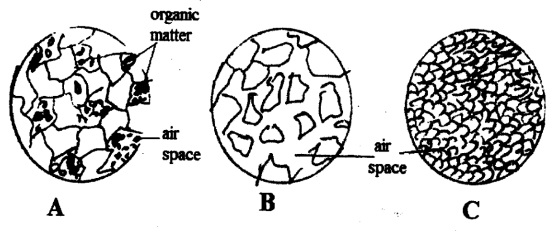
(i)
Identify each of the soil types labelled A, B and C
(ii)
Describe each of the soils under the following properties:
(α)
Particle size
(β)
Air space
(iii)
State two ways of improving soil type B for vegetable cultivation.
The diagrams below illustrate an experimental set-up on a physical property of soil using three soil types X, Y and Z.
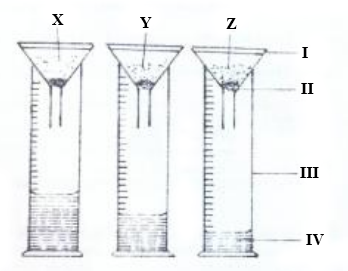
Study the set-up carefully and answer the questions that follow:
(i)
Name the parts of the set-up labelled I, II, III and IV.
(ii)
Which of the three soil types has the
(α)
highest water holding capacity?
(β)
least water holding capacity?
(iii)
Name each of the three soil types X, Y and Z.
(iv)
Suggest a suitable title for the experiment.
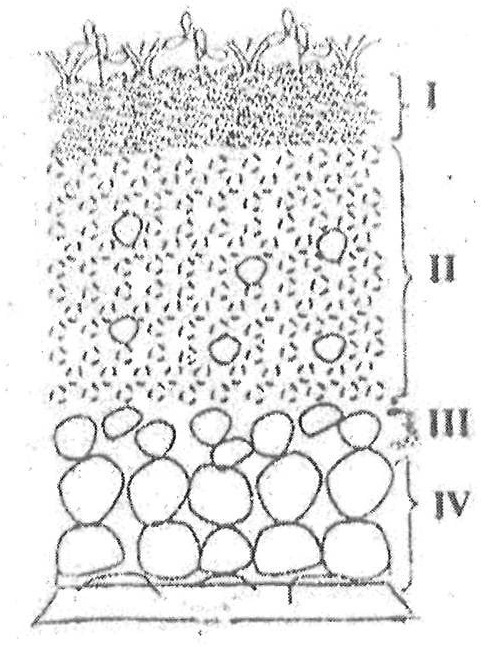
The diagram below is an illustration of a section through the soil.
Study the diagram carefully and answer the questions that follow.
i)
What does the diagram represent?
ii)
Name each of the parts labelled I, II, III, IV.
iii)
Which part of the diagram:
α)
is the richest in humus?
β)
is the habitat for soil organisms?
γ)
undergoes weathering?
iv)
What is the effect of heavy rainfall on the part labelled I?
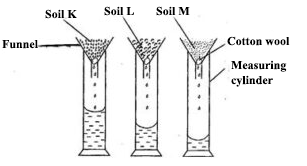
The funnels in the diagram below contain equal amounts of different types of soil labelled K, L and M. Equal volumes of water were poured onto each soil at the same time and allow to drain for 20 minutes.
Study the diagram carefully and answer the questions that follow.
i)
What is the aim of the experiment?
ii)
Which soil has the highest rate of drainage?
iii)
Which soil has the highest water retention capacity?
iv)
Which soil is mostly likely to lose water and dry faster after rainfall?
v)
Which soil is mostly likely to be waterlogged after rainfall?
vi)
Which of the soil types would be suitable for maize cultivation?
You are provided with two dry soil samples A and B, a measuring cylinder, beakers, funnels, filter paper, beam balance, stop watch and water. With the aid of a labelled diagram, describe an experiment to find out which of the two soil samples can hold more water.


Digital Address: GZ-033-0057
King Kotey Road
Teshie - Accra
Ghana
+233 54 753 9118
info@kuulchat.com

© Copyright 2015 - 2026
All Rights Reserved