
Finwaver.com
Your school or business runs better on finwaver.com. Sign up for free one (1) week try.
1.
To test for starch in a green leaf, it is usually boiled to
isolate the starch.
kill the leaf.
make the leaf soft.
extract the chlorophyll.
2.
When a green leaf is placed in a test tube containing ethanol and heated over a water bath the leaf
becomes soft
changes colour to brown
changes colour to blue-black
is decolorized
3.
Chlorophyll helps plants absorb energy from the sun as they undergo the process of photosynthesis. It is located in a structure called
chloroplast.
mitochondrion.
vacuole.
nucleus.
4.
Plants lose water through a process called
photosynthesis
fertilization
transpiration
respiration
5.
Photosynthesis in plants requires chlorophyll, sunlight, water and
oxygen
carbon dioxide
steam
hydrogen
6.
In an experiment in which a variegated leaf is used, which of the following is proved to be necessary for photosynthesis?
Carbon dioxide
Light
Chlorophyll
Water
7.
Which of the following environmental factors can cause the fastest rate of water loss from leaf surfaces?
High humidity
Wet wing
Still air
Low temperature
8.
Photosynthesis occurs only in green plants because they
absorb water
are found in the tropics
are very active
contain chlorophyll
9.
Which of the following substances is necessary for the formation of food in plants?
Carbon dioxide
Nitrogen
Oxygen
Starch
10.
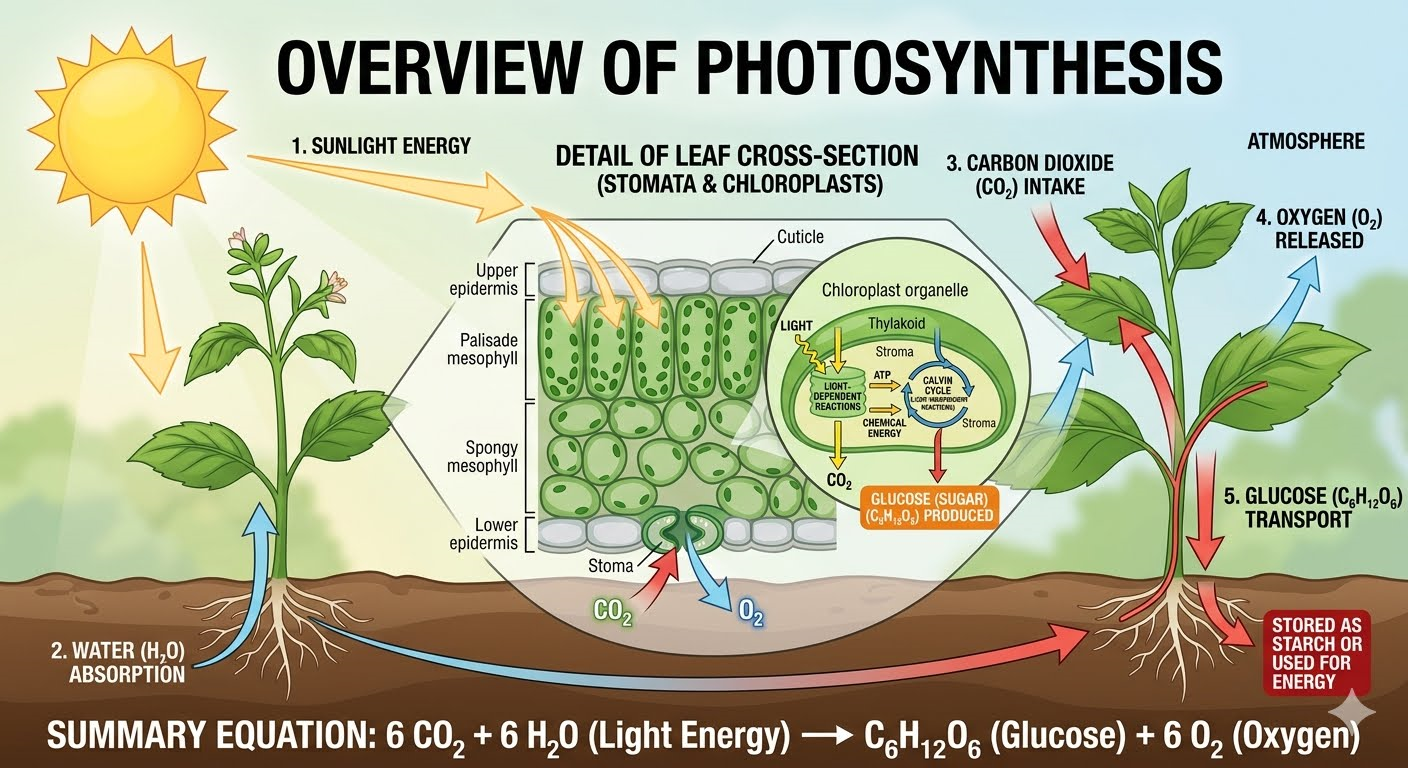
The equation Carbon (IV) oxide + water Chlorophyll→Light Glucose + Oxygen, represents
Breathing
Diffusion
Photosynthesis
Respiration
11.
Plants manufacture their food using
I. carbon dioxide
II. oxygen
III. light
IV. chlorophyll
I only
II only
I and II only
I, III and IV only
12.
The by-product of photosynthesis is
carbon dioxide.
starch.
oxygen.
water.
13.
Which of the following gases is given out during photosynthesis?
Carbon dioxide
Carbon monoxide
Nitrogen
Oxygen
14.
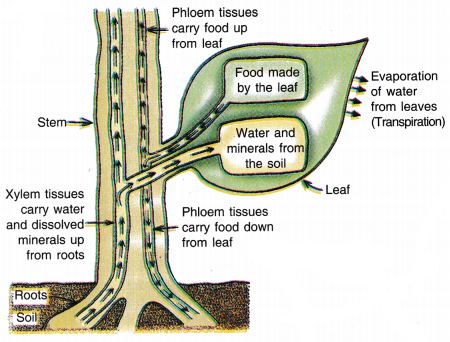
Food substances are transported from the leaves to various parts of a plant through the
cambium.
epidermis.
phloem.
xylem.
15.
The substance that enables green plants to trap sunlight for the manufacture of food is
chlorophyll.
chloroplast.
phloem.
xylem.
16.
Water is absorbed by roots in plants and transported to the leaves through the
chlorophyll.
phloem.
stomata.
xylem.
17.
The food manufactured by a plant is distributed to all parts of the plant through the
chlorophyll.
phloem.
stomata.
Xylem.
18.
The process by which water vapour moves through the stomata of leaves into the atmosphere is known as
absorption.
diffusion.
osmosis.
transpiration.
19.
The presence of chlorophyll in green plants is a necessary condition for photosynthesis because it
absorbs oxygen.
absorbs solar energy.
produces carbon dioxide.
produces water vapour.
20.
When a green leaf is placed in a test tube containing ethanol and heated over a water bath the leaf
becomes soft
changes colour to brown
changes colour to blue-black
is decolorized
21.
Gases enter and leave the leaf of a plant through the
mesophyll cells.
stomata.
pith.
palisade cells.
22.
Photosynthesis is important to living organisms because it produces
glucose and oxygen.
glucose and carbon dioxide.
oxygen and carbon dioxide
water and carbon dioxide.
23.
Which of the following is used by plants to make its food?
carbon monoxide
oxygen
carbon dioxide
hydrogen
24.
Photosynthesis occurs only in green plants because they
absorb water
are found in the tropics
are very active
contain chlorophyll
25.
Which of the following statements about photosynthesis is correct?
It occurs in the presence of light energy.
Oxygen is the main product.
Plants obtain water from the atmosphere to make food.
Leaves without chlorophyll are able to photosynthesize.


Digital Address: GZ-033-0057
King Kotey Road
Teshie - Accra
Ghana
+233 54 753 9118
info@kuulchat.com

© Copyright 2015 - 2026
All Rights Reserved