
Finwaver.com
Your school or business runs better on finwaver.com. Sign up for free one (1) week try.
1.
The angle of reflection of a ray is 40°. Determine the angle between the surface of the mirror and the ray.
40°
50°
80°
180°
2.
A person who suffers from myopia
cannot see at all.
can see clearly from far.
can see clearly objects closer.
wears a converging lens for correction.
3.
The shape of the lens of the human eye is varied by the action of the
iris.
pupil.
ciliary muscle.
suspensory ligament.
4.
The size of the pupil of the eye is controlled by the
iris.
conjunctiva.
cornea.
lens.
5.
Myopia s an eye defect that makes a sufferer to
feel dizzy continuously
view far away objects but not near objects.
view normally.
view near objects but not far away objects.
6.
The angle of reflection of a ray is 40°. Determine the angle between the surface of the mirror and the ray.
40°
50°
80°
180°
7.
The diagram below illustrates a ray of light incident on a plane mirror MM'.
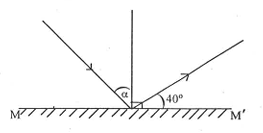
The value of α is
40°
50°
80°
100°
8.
Which of the following lights will combine with red light to give white light?
Cyan
Green
Magenta
Yellow
9.
Which of the following statements about the image formed in a pinhole camera are correct? The image is
I. inverted.
II. upright.
III. real.
II and III only
I and III only
I and II only
I and II only
10.
When red light is mixed with green light, the product is
blue light.
cyan light.
magenta light.
yellow light.


Digital Address: GZ-033-0057
King Kotey Road
Teshie - Accra
Ghana
+233 54 753 9118
info@kuulchat.com

© Copyright 2015 - 2026
All Rights Reserved