1.
The process by which liquid changes into vapour at a particular temperature is known as
boiling.
condensation.
evaporation.
melting.
2.
Fluid consists of
solid and liquid only.
liquid and gas only.
gas and solid only.
liquid, solid and gas.
3.
Which of the following statements about compounds are correct
I. They are products of chemical combination.
II. Their constituents are present in fixed ratio by mass
III. Their constituents keep their individual properties
I and II only
I and III only
II and III only
I, II and III
4.
Which of the following compounds is a neutral oxide?
CO2
NO2
MgO
CO
5.
A gas that gives a pop sound with a flame is
ammonia.
carbon (IV) oxide.
hydrogen.
nitrogen.
6.
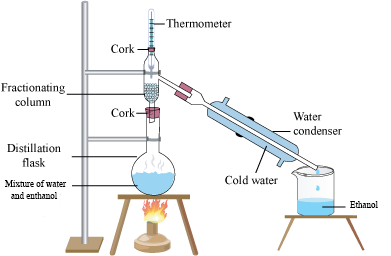
The set-up used to separate water from ethanol should include
separating funnel.
burette.
condenser.
volumetric flask.
7.
The number of electrons present in the outermost shell of an element with atomic number 20 is
2
6
8
10
8.
The neutrons and protons in the nucleus of an atom are collectively called
mass number.
neutrons.
nucleons.
atomic number.
9.
Which of the following statements about an atoms is correct?
Protons out number electrons in a neutral atom
The L-shell is closest to the nucleus
Neutrons are found in the nucleus
The atomic number is greater than the mass number
10.
Carbon (IV) oxide is used to extinguish fires because it
is fully oxidized.
occurs naturally.
is heavier than air.
is a reducing agent.
11.
Which of the following deductions cannot be made from the symbol 612 C?
Mass number of the element
Atomic number of the element
Number of neutrons in the nucleus
Relative atomic mass of the element
12.
The substance formed when carbon (IV) oxide s bubbled through lime water for a long time is
Ca(HCO3)2.
Na2CO3.
NaHCO3.
CaCO3.
13.
A solution contains 5.3 g of sodium trioxocarbonate (IV) per dm3. Determine its molarity.
[Na2CO3 = 106]
0.020 mol dm-3
0.050 mol dm-3
0.030 mol dm-3
0.040 mol dm-3
14.
A quantity of NaCl was dissolved in 100 cm3 of solution to obtain 0.50 moldm-3 NaCl solution.
Determine the mass of NaCl used.
[NaCl = 58.5]
2.54 g
25.40 g
2.93 g
29.35 g
15.
Given that the Avogadro's constant is 6.02 x 10²³, determine the number of atoms in 0.001 mol of aluminium metal.
6.02 x 1026
6.02 x 10²⁰
3.01 x 10²⁰
12.30 x 10²³
16.
The component of air used for welding is
O2.
N2.
CO2.
C2H2.
17.
In the periodic table, all the elements within the same group have the same
number of electrons available for bonding.
atomic number.
number of neutrons in the nuclei.
number of isotopes.
18.
The gas produced when dilute hydrochloric acid reacts with trioxocarbonate (IV) salt is
carbon (IV) oxide.
Carbon (II) oxide.
hydrogen.
ammonia.
19.
The process by which liquid changes into vapour at a particular temperature is known as
boiling.
condensation.
evaporation.
melting.
20.
Fluid consists of
solid and liquid only.
liquid and gas only.
gas and solid only.
liquid, solid and gas.
21.
Which of the following statements about compounds are correct
I. They are products of chemical combination.
II. Their constituents are present in fixed ratio by mass
III. Their constituents keep their individual properties
I and II only
I and III only
II and III only
I, II and III
22.
The number of electrons present in the outermost shell of an element with atomic number 20 is
2
6
8
10
23.
The neutrons and protons in the nucleus of an atom are collectively called
mass number.
neutrons.
nucleons.
atomic number.
24.
Which of the following statements about an atoms is correct?
Protons out number electrons in a neutral atom
The L-shell is closest to the nucleus
Neutrons are found in the nucleus
The atomic number is greater than the mass number
25.
Which of the following deductions cannot be made from the symbol 612 C?
Mass number of the element
Atomic number of the element
Number of neutrons in the nucleus
Relative atomic mass of the element
26.
The principle of flotation states that
a floating body displaces its own weight of fluid in which it floats.
a floating body experiences an upward force equal to its weight.
a body immersed in a fluid does not displace the fluid.
the upthrust on a floating body exceeds the body's weight.
27.
A solution contains 5.3 g of sodium trioxocarbonate (IV) per dm3. Determine its molarity.
[Na2CO3 = 106]
0.020 mol dm-3
0.050 mol dm-3
0.030 mol dm-3
0.040 mol dm-3
28.
A quantity of NaCl was dissolved in 100 cm3 of solution to obtain 0.50 moldm-3 NaCl solution.
Determine the mass of NaCl used.
[NaCl = 58.5]
2.54 g
25.40 g
2.93 g
29.35 g
29.
Given that the Avogadro's constant is 6.02 x 10²³, determine the number of atoms in 0.001 mol of aluminium metal.
6.02 x 1026
6.02 x 10²⁰
3.01 x 10²⁰
12.30 x 10²³
30.
An instrument that could be used to measure the relative density of an acid is
anemometer.
hydrometer.
barometer.
hygrometer.
31.
Addition of an atom of a pentavalent element to a tetravalent element
I. is known as doping.
II. forms an n-type semiconductor.
III. forms a p-type semiconductor.
I and II only
I and III only
II and III only
I, II and III
32.
In the periodic table, all the elements within the same group have the same
number of electrons available for bonding.
atomic number.
number of neutrons in the nuclei.
number of isotopes.
33.
Natural fats are composed of
carbon, hydrogen and oxygen.
carbon, hydrogen and nitrogen.
carbon, oxygen and nitrogen.
hydrogen, oxygen and nitrogen,
34.
A substance that contains 10 electrons and 11 protons is
a halogen.
a noble gas.
an ion.
an atom.
35.
How many moles of oxygen are present in 4.0 g of the gas?
0.25
0.50
0.75
1.00
36.
The volume occupied by 0.02 moles of a gas at standard temperature and pressure is
0.224 dm3
0.240 dm3
0.448 dm3
4.480 dm3
37.
Smoke is a mixture of
liquid and gas.
gases.
solid and gas.
solid, liquid and gas.
38.
The elements in bronze are
copper and zinc.
copper and lead.
copper and nickel.
copper and tin.
39.
Which of the following factors can affect the boiling and freezing points of water?
Surface tension
Adhesive forces
Impurities
Density
40.
The major reason why relative atomic mass of some elements is not a whole number is the existence of
isomerism.
allotropy.
isotopy.
isotonism.
41.
The number of protons in an ion with a charge of +3 is 13. How many electrons are present in the neutral atom?
10
13
16
20
42.
Calculate the number of moles in 5.85 of NaCl.
[Na = 23; Cl = 35.5]
0.01
0.10
1.00
10.00
43.
A solution of 250 cm3 HCl has a concentration of 2 mol dm-3. Determine the number of moles of the acid.
0.25 moles
0.50 moles
1.00 moles
1.50 moles
44.
Determine the volume of water required to change the concentration of 100 cm3 HCl from 0.5 mol dm-3 to 0.1 mol dm-3.
100 cm3
200 cm3
400 cm3
500 cm3
45.
The main constituent of natural gas is
ethane.
helium.
methane.
nitrogen.
46.
A 250 cm3 of 0.10 mol dm-3 of KOH is to be prepared. Calculate the mass of KOH required.
[K = 39, O = 16, H = 1]
1.0 g
1.4 g
7.0 g
14.0 g
47.
Nucleons refer to the sum of
electrons and neutrons in an atom
protons and neutrons in an atom
protons and electrons in an atom
electrons and molecules in an atom
48.
Determine the number of atoms in 0.12 g of carbon. (Avogadro's number = 6.02 × 10²³ mol⁻¹, C = 12)
6.02 × 10²¹ atoms
3.01 × 10²³ atoms
6.02 × 10²³ atoms
12.30 × 10¹⁶ atoms
49.
What is the chemical formula for Nitrogen (II) oxide?
N₂O
N₂O₄
NO
NO₂


Digital Address: GZ-033-0057
King Kotey Road
Teshie - Accra
Ghana
+233 54 753 9118
info@kuulchat.com

© Copyright 2015 - 2026
All Rights Reserved